Faculty Senate Minutes Regular Meeting March 27, 2014
The Faculty Senate was called to order by Robert Rosenman, Chair on Thursday March 27, 2014, in FSHN T101 at 3:30
p.m. Thirty-two (32) members were present with eighteen (18) absent and five (5) nonvoting members present.
Minutes of March 13, 2014 meeting were approved as circulated.
Announcements (Information items).
- Senate Officers met with Interim Provost Bernardo on March 11, 2014.
- Senate Officers met with President Floyd on March 13, 2014.
- Richard Zack has been elected as Chair Elect of the Senate.
- Minor Change Bulletin #8 (Exhibit F).
| M E M O R A N D U M TO: Deans and Chairs FROM: Becky Bitter, Assistant Registrar DATE: March 13, 2014 SUBJECT: Minor Change Bulletin No. 8 The courses listed below reflect the minor curricular changes approved by the catalog editor since approval of the last Minor Change Bulletin. The column to the far right indicates the date each change becomes effective. | |||||
| Subject | Course Number | New Revise Drop | Current | Proposed | Effective Date |
| COM | 490 | Revise | Web Design and Usability 3 Course Prerequisite: COM 320; COM 420; COMSOC 324; COMSTRAT 309; certified major in Communication. Web design with an emphasis or user- centered design and usability. | Web Design and Usability 3 Course Prerequisite: COM 320; COM 420; COMSOC 324 or COMSTRAT 383; COMSTRAT 309; certified major in Communication. Web design with an emphasis or user-centered design and usability. | 8-14 |
| COMSOC | 480 | Revise | Science Communication Campaigns 3 Course Prerequisite: COMSOC 324; COMSTRAT 309; COMSTRAT 310; certified major in Communication. Develop an | Science Communication Campaigns 3 Course Prerequisite: COMSOC 324 or COMSTRAT 383; COMSTRAT 309; COMSTRAT 310; certified | 8-14 |
| effective communication campaign to address a science communication challenge. | major in Communication. Develop an effective communication campaign to address a science communication challenge. | ||||
| COMSTRAT | 383 | Revise | Media Strategies and Techniques for Public Relations 3 Course Prerequisite: COM 210; COM 295 or 300; certified major in Communications. Development of creative content for persuasive public relations campaigns through different media. | Media Strategies and Techniques for Public Relations 3 Course Prerequisite: COM 210; COM 295 or 300 with a C or better; certified major in Communications. Development of creative content for persuasive public relations campaigns through different media. | 8-14 |
| COMSTRAT | 485 | Revise | [M] Public Relations Management and Campaigns 3 Course Prerequisite: COMSTRAT 309 or 409; COMSTRAT 312; COMSTRAT 381; certified major in Communication. Application of public relations principles, management, persuasion theory and research methods to public relations issues. | [M] Public Relations Management and Campaigns 3 Course Prerequisite: COMSTRAT 309 or 409; COMSTRAT 312; COMSTRAT 381 or COMSTRAT 383; certified major in Communication. Application of public relations principles, management, persuasion theory and research methods to public relations issues. | 8-14 |
| CS | 317 | Revise | Automata and Formal Languages 3 Course Prerequisite: CS 122 with a C or better; CS 216 with a C or better. Finite automata, regular sets, pushdown automata, context-free language, Turing machines and the halting problem. | Automata and Formal Languages 3 Course Prerequisite: CS 122 with a C or better; CS 216 with a C or better; certified major in Computer Science. Finite automata, regular sets, pushdown automata, context- free language, Turing machines and the halting problem. | 8-14 |
| CS | 320 | Revise | [M] Fundamentals of Software Engineering 3 Course Prerequisite: CS 224 with a C or better; CS 216 with a C or better; ENGLISH 402 with a C or better or concurrent enrollment. Introduction to software engineering; requirements analysis, definition and | [M] Fundamentals of Software Engineering 3 Course Prerequisite: CS 224 with a C or better; CS 216 with a C or better; ENGLISH 402 with a C or better or concurrent enrollment; certified major in Computer Science. Introduction to software engineering; | 8-14 |
| specification; software process models; prototyping; architecture; object-oriented design with UML. | requirements analysis, definition and specification; software process models; prototyping; architecture; object-oriented design with UML. | ||||
| CS | 330 | Revise | Numerical Computing 3 Course Prerequisite: CS 251 with a C or better, or CS 261 with a C or better; MATH 172 or 182 with a C or better; MATH 220 with a C or better. Power and limitation of numerical solutions; design, analysis and implementation of numerical algorithms; visualization and rendering. | Numerical Computing 3 Course Prerequisite: CS 251 with a C or better, or CS 261 with a C or better; MATH 172 or 182 with a C or better; MATH 220 with a C or better; certified major in Computer Science. Power and limitation of numerical solutions; design, analysis and implementation of numerical algorithms; visualization and rendering. | 8-14 |
| CS | 351 | Revise | Introduction to Database Systems 3 Course Prerequisite: CS 223 with a C or better; CS 224 with a C or better. Introduction to database concepts, data models, database languages, database design, implementation issues. | Introduction to Database Systems 3 Course Prerequisite: CS 223 with a C or better; CS 224 with a C or better; certified major in Computer Science. Introduction to database concepts, data models, database languages, database design, implementation issues. | 8-14 |
| CS | 355 | Revise | Programming Language Design 3 Course Prerequisite: CS 223 with a C or better; CS 224 with a C or better. Design concepts of high-level programming languages; survey of existing languages, experience using some languages. | Programming Language Design 3 Course Prerequisite: CS 223 with a C or better; CS 224 with a C or better; certified major in Computer Science. Design concepts of high-level programming languages; survey of existing languages, experience using some languages. | 8-14 |
| CS | 360 | Revise | Systems Programming 4 (3-3) Course Prerequisite: CS 224 with a C or better; CS 251 with a C or better, or CS 261 with a C or better. Implementation of systems programs, concepts of computer operating systems; laboratory experience in using operating system facilities. | Systems Programming 4 (3-3) Course Prerequisite: CS 224 with a C or better; CS 251 with a C or better, or CS 261 with a C or better; certified major in Computer Science. Implementation of systems programs, concepts of computer operating systems; laboratory experience in using operating system facilities. | 8-14 |
| CS | 443 | Revise | Human-Computer Interaction | Human-Computer Interaction | 8-14 |
| 3 Course Prerequisite: Junior standing. Introduction to the field of human-computer interaction; understanding the system user; user-centered design and evaluation techniques including heuristic evaluation and usability testing. | 3 Course Prerequisite: Certified major in Computer Science; junior standing. Introduction to the field of human-computer interaction; understanding the system user; user-centered design and evaluation techniques including heuristic evaluation and usability testing. | ||||
| CS | 450 | Revise | Design and Analysis of Algorithms 3 Course Prerequisite: CS 223 with a C or better; STAT 360 with a C or better. Analysis of data structures and algorithms; computational complexity and design of efficient data-handling procedures. | Design and Analysis of Algorithms 3 Course Prerequisite: CS 223 with a C or better; STAT 360 with a C or better; certified major in Computer Science. Analysis of data structures and algorithms; computational complexity and design of efficient data-handling procedures. | 8-14 |
| E M | 570 | Revise | Six Sigma Quality Management 3 | Six Sigma Quality Management 3 Quality management programs, quality assurance, statistical quality control concepts and product design reliability. | 5-14 |
| ENGR | 520 | Drop | Multidisciplinary Engineering Design I 3 (1-4) Needs analysis and conceptualization of technological products and business plan for target market; multidisciplinary team development. Credit not granted for both ENGR 420 and ENGR 520. Offered at 400 and 500 level. | –N/A-– | 8-14 |
| ENGR | 521 | Drop | [T] [M] Multidisciplinary Engineering Design II 3 (1-4) Prototype solution developed and evaluated and business plan completed; presentation to stake holders; team development and assessment. Credit not granted for both ENGR 421 and ENGR 521. Offered at 400 and 500 level. | –N/A-– | 8-14 |
| ENVR SCI | 404 | Drop | [M] The Ecosystem 3 Course Prerequisite: CHEM 345; PHYSICS 102 or 202; or | –N/A-– | 8-14 |
| graduate standing. Ecosystem organization and processes; theory and applications to contemporary environmental problems. Recommended preparation: BIOLOGY 372. | |||||
| ENVR SCI | 482 | Drop | Special Topics: Study Abroad V 1-15 May be repeated for credit. S, F grading. | –N/A-– | 8-14 |
| ENVR SCI | 594 | Drop | Environmental and Natural Resources Issues and Ethics 3 Ethical systems applied to natural resources; issues of professionalism and ethics in natural resource management. (Crosslisted course offered as NATRS 594, ENVR SCI 594). Cooperative: Open to UI degree- seeking students. | –N/A-– | 8-14 |
| MBIOS | 568 | Revise | Advanced Topics in Molecular Biosciences V 1-3 May be repeated for credit. | Advanced Topics in Molecular Biosciences V 1-3 May be repeated for credit. Recent research in selected areas of molecular biosciences. | 8-14 |
| NATRS | 416 | Drop | Fisheries Management 4 (3-3) Techniques employed in sampling and application of principles toward managing recreational and commercial aquatic resources. (Crosslisted course offered as NATRS 416, BIOLOGY 416). Recommended NATRS 411. Recommended preparation: NATRS 411. Cooperative: Open to UI degree- seeking students. | –N/A-– | 8-14 |
| NATRS | 421 | Drop | Fish Health Management 4 (3- 3) Course Prerequisite: MBIOS 101. Epidemiology, prevention, diagnostics, and treatment of infectious and non-infectious diseases of free-living and confined finfish and shellfish. | –N/A-– | 8-14 |
| NATRS | 488 | Drop | Senior Thesis in Natural Resources V 3-6 May be | –N/A-– | 8-14 |
| repeated for credit; cumulative maximum 6 hours. Course Prerequisite: Certified major in Natural Resource Sciences; senior standing. | |||||
| SOIL SCI/ ENVR SCI | 468/568 | Revise | GIS Spatial Analysis 4 (2-6) Course Prerequisite: SOIL SCI 368. Geographic information systems applied to analysis of landscape data; maps, geographic coordinate systems and projections, geodatabases. (Crosslisted course offered as SOIL SCI 468, SOIL SCI 568, ENVR SCI 486, ENVR SCI 586). Offered at 400 and 500 level. | 5-14 |
- Revisions of the Bylaws for the Graduate programs to the Environmental and Natural Resource Sciences for the PhD Program, submitted by the School of the Environment are available on the department’s website.
- Revisions of the Bylaws for the Graduate programs to the Geology PhD Program, submitted by the School of the Environment are available on the department’s website.
- Revisions of the Bylaws for the Graduate programs to the Geology for the Masters of Science Program, submitted by the School of the Environment are available on the department’s website.
- Revisions of the Bylaws for the Graduate programs to the College of Business, PhD Program are available on the department’s website.
- Revisions of the Bylaws for the Graduate programs to the Educational Psychology submitted by the Department of Educational Leadership, Sport Studies, and Educational/ Counseling Psychology are available on the department’s website.
- Revisions of the Bylaws for the Graduate programs to the Environmental Science for the Masters of Science Program, submitted by the School of the Environment are available on the department’s website.
- Revisions of the Bylaws for the Graduate programs to the Natural Resource Sciences for the Masters of Science Program, submitted by the School of the Environment are available on the department’s website.
- Addition of a new chapter (13) to the Graduate School Policies and Procedures, relating to the Doctor of Nursing Practice (DNP) Requirements are available on the department’s website.
- Announcements (Reports).
- Remarks by the Chair.—R. Rosenman
- Task forces were formed to review the Annual Review process and the Plagiarism software. Robby Rosenman and Fran McSweeney are the faculty representatives. A third task force will review the winter session closure and Robert Greenberg is the Faculty Senate representative.
- Faculty Status Committee elections are on-going; please make sure to vote.
- You are encouraged to go to Showcase.
- Remarks by the Chair.—R. Rosenman
- Additions or Changes to the Agenda.
- None.
- Agenda Items. (Action Items)
- Recommendation From Steering Committee on the Policy on Assessing Student Learning in Degrees (Exhibit U) MOTION CARRIED, WITH AMENDMENT.
- Discussion: It was noted there was concern about the language and how it would affect teaching efforts.
- MOTION: To have this policy reviewed by Faculty Senate in two (2) years. MOTION CARRIED.
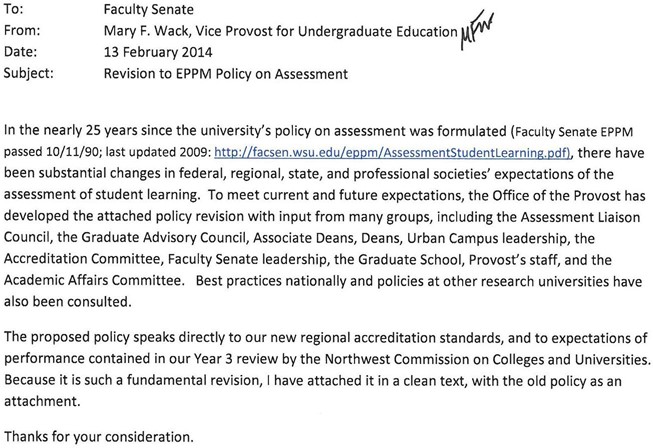
Assessment of Student Learning in Degree Programs
(Faculty Senate 10/11/90; updated 3/27/14)
Introduction. The following policy governs the system for regular and ongoing assessment of student learning in WSU undergraduate, professional and graduate degree programs.
Definition. For the purposes of this policy, assessment refers to assessment at the program level, focusing on student learning in the program of study for a degree.Program assessment is an ongoing process to support educational quality and student achievement.
Purpose. The purpose for program assessment of student learning is to provide an accurate and honest appraisal of where students fully meet expected program-level learning outcomes, where there is room for improvement, and what strategies faculty, departments, colleges, and WSU are using to support and improve student learning. Assessment results can provide valuable information to faculty and program leadership to assist them in making informed decisions regarding their programs. WSU seeks to ensure that assessment occurs consistently and systematically and that its results contribute to university-wide planning that supports quality education.
Essential elements. Every degree must publish student learning outcomes and implement a faculty-developed plan to assess student learning, including measure(s) near the end of the program of study. The Office of the Provost, with input from the Office of Assessment of Teaching and Learning, the Graduate School, and their respective advisory councils, may specify other requirements to support useful assessment and meet standards for WSU’s accreditation (see policies of interest, appended).
Responsibilities and Process. Roles and responsibilities for program assessment are outlined below. These may be adapted as needed by undergraduate, professional and graduate programs or by programs or colleges with specialized accreditation or highly individualized programs of study; the program’s assessment plan should specify any alternative distribution of responsibilities and processes. The purpose of designating roles and responsibilities is to efficiently provide useful assessment in each program’s context, meet requirements for specialized accreditation or licensure, contribute data to the institution, and support WSU’s accreditation.
Faculty. For each degree, faculty with teaching responsibilities have a primary role in assessing student achievement of clearly identified, program-level student learning outcomes. Learning outcomes should guide the curriculum and be widely-publicized (e.g. department website, student handbook) and periodically reviewed for currency and utility, with input from appropriate stakeholders. Methods of assessment should include both direct and indirect measures, may vary from program to program, may rely on sampling, and may include external measures, e.g. licensure examinations. Ideally, all faculty within a program, particularly those with teaching responsibilities, regularly review, discuss, and decide how to act on assessment data.
Department/School The chair/school/program director is responsible for working with faculty to a) ensure each degree program has learning outcomes and an assessment plan that involves all campuses offering the degree, including online degrees, b) implement the program’s assessment plan, c) share results with faculty on all campuses offering the degree, and d) manage implementation of program improvements based on assessment results. With coordinating assistance from the Office of the Assessment of Teaching and Learning, the chair/director reports on assessment annually to the dean, urban campus leadership for multi- campus programs, and the provost. Graduate and professional program chairs/directors report to the Graduate School on an annual basis. Reports include information adequate for interpretation of the data, including the role of faculty in assessment, and use of assessment data in decisions, improvements, or planning. Results and improvements should be coordinated and discussed with the dean and campus leadership, as appropriate.
Leaders of degree programs outside a department or school structure have the same assessment responsibilities as a chair or school director.
College Dean/Campus Leadership. The dean is responsible for implementing effective assessment of student learning college-wide; establishing appropriate procedures and resources in the college; ensuring data flow and availability to appropriate constituencies on all campuses; monitoring aggregate and disaggregate results; using results of assessment of student learning to inform strategic planning and academic or learning support planning and practices designed to enhance student achievement. The dean is responsible for appropriately involving other campus leadership, such as vice chancellors, academic directors, or other designees who are responsible for implementing program assessment on their campuses. Institutional leadership.
Provost. Annually, the Provost reviews and shares the status of assessment with leadership and appropriate university constituencies in a timely manner.
Dean of Graduate School. The Graduate School assists, coordinates and reviews graduate and professional program assessment. Annually, the Dean of the Graduate School reviews and shares the status of graduate and professional program assessment with leadership and appropriate university constituencies in a timely manner.
Office of Assessment of Teaching and Learning: The Office of Assessment of Teaching and Learning assists, coordinates and reviews undergraduate program assessment. Annually, the director of the OATL reviews and shares the status of undergraduate program assessment with leadership and appropriate university constituencies in a timely manner.
Participation in Assessment.
Annual Review. The Provost, Deans, and department/school heads are expected to recognize and acknowledge faculty and staff participation in assessment activities through the annual review process at all levels.
Academic Freedom. Faculty Senate affirms that assessment requirements do not violate academic freedom, and that responsibilities for assessment are addressed by the Association of American Colleges and Universities Statement on Academic Freedom and Educational Responsibilities (2006):
Faculty are responsible for establishing goals for student learning, for designing and implementing programs of general education and specialized study that intentionally cultivate the intended learning, and for assessing students’ achievement. In these matters, faculty must work collaboratively with their colleagues in their departments, schools, and institutions as well as with relevant administrators. Academic freedom is necessary notjust so faculty members can conduct their individual research and teach their own courses but so they can enable students- through whole programs of study- to acquire the learning they need to contribute to society.
Resources and Good Practices. Good practices and resources are available through the Provost Office, the Office of Assessment of Teaching and Learning, and the Graduate School to support faculty, programs, and leadership in assessment, and help coordinate efforts.
University Accreditation. Program assessment activities and use of results are essential to maintaining WSU’s accreditation by the Northwest Commission on Colleges and Universities (see related policies of interest below).
Periodic Review. The process of program assessment will be reviewed periodically by the Provost, Graduate School and college and campus leadership, and Faculty Senate, and necessary adjustments made so that assessment efforts provide useful data based on sustainable practices, and support continuing institutional accreditation. Periodic input will also be sought from colleges, campuses, and departments.
Related policies of interest
Northwest Commission on Colleges and Universities (NWCCU). http://nwccu.org/index.htm
NWCCU is our regional accreditor. Standards for maintaining the university’s accreditation include the following:
Eligibility Requirement 22. Student Achievement: The institution identifies and publishes the expected learning outcomes for each of its degree and certificate programs. The institution engages in regular and ongoing assessment to validate student achievement of these learning outcomes.
Standard 4.A.3. The institution documents, through an effective, regular, andcomprehensive system of assessment of student achievement, that students who complete itseducational courses, programs, and degrees, wherever offered and however delivered, achieve identified course, program, and degree learning outcomes. Faculty with teaching responsibilities are responsible for evaluating student achievement ofclearly identified learning outcomes.
Standard 4.A.6. The institution regularly reviews its assessment processes to ensure they appraise authentic achievements a nd yield meaningful results that lead to improvement.
Standard 4.B.2. The institution u es the results of its assessment of student learning to inform academic and learning- support planning and practices that lead to enhancement of student learning achievements. Results of student learning assessments are madeavailable to appropriate constituencies in a timely manner.
Washington Student Achievement Council (WSAC) http://www .wsac.wa.gov/
Established as a new cabinet-level state agency onJuly 1,2012, the Washington Student Achievement Council provides strategic planning, oversight, and advocacy to support increased student success and higher levels ofeducational attainment in Washington. WSAC publishes data onstudent achievement and makes recommendations to the legislature.
WSU Executive Policy #29 (5/5/2009) http://www.wsu.edu/forms2/ALTPDF/EPM/EP29 .pdf
This policy identifies responsibilities for multi-campus program assessment, including Student Outcomes Assessment as follows: Department and schools are responsible for overseeing student outcome assessment on all campuses contributing to/participating in the program. Campus academic directors are responsible for implementing departmental/ school student outcomes assessment processes on their campuses.
WSU Faculty Manual
Pursuant to the mission of the University (Faculty Manual (2010), p. 2-3), WSU is mandated to provide specific educational outcomes to its undergraduate and graduate students. In fulfillment of this mission, academic responsibility for a given academic unit is from the academic faculty through the chair or director, through the academic dean and to the Provost
(Faculty Manual (2010),Section I:A, p.7).
***** Motions Carried
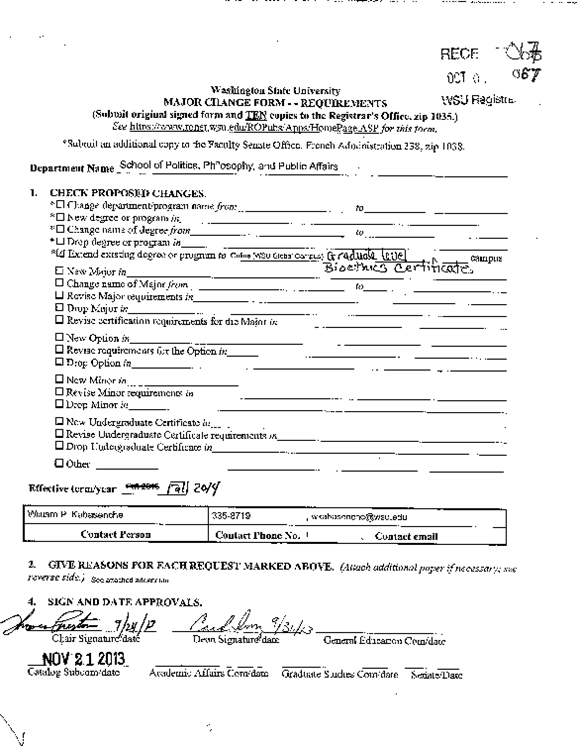
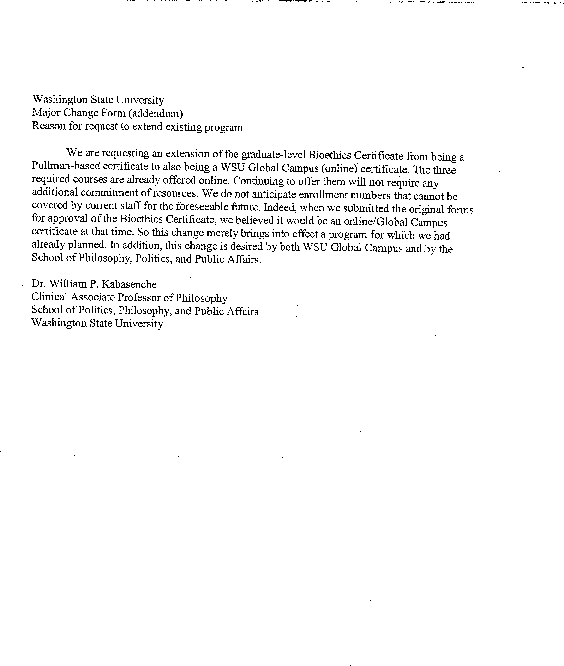
- Recommendation from Graduate Studies Committee on the proposal to extend the graduate certificate in Bioethics offered by the School of Philosophy, Politics, and Public Affairs to the WSU Global Campus (Exhibit V, V1 ) as follows:
MEMORANDUM
TO: Dorene Branson, Principal Assistant
Faculty Senate
FROM: Graduate Studies Committee DATE: February 19, 2014 SUBJECT: Bioethics Certificate
On Tuesday, February 18th, the Graduate Studies Committee approved the proposal to extend the graduate certificate in Bioethics offered by the School of Philosophy, Politics, and Public Affairs to the WSU Global Campus. Please forward this to the Faculty Senate for appropriate approvals.
*****MOTON CARRIED
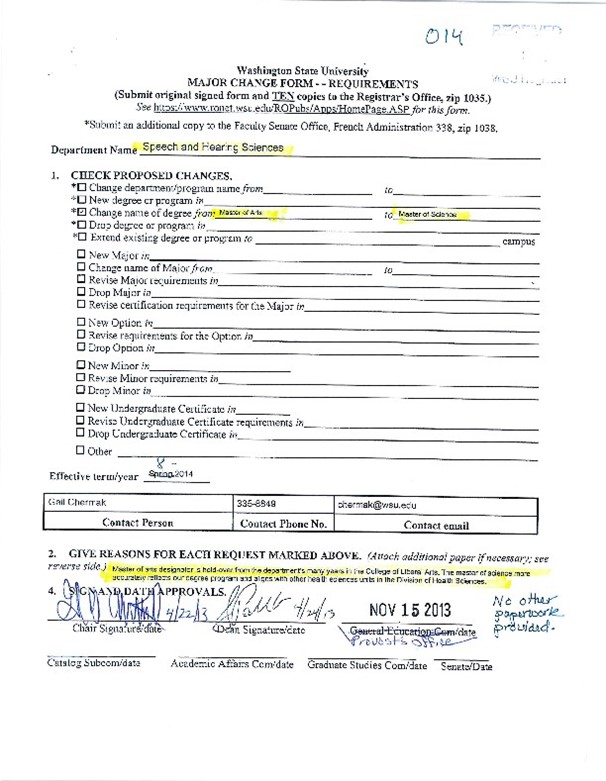
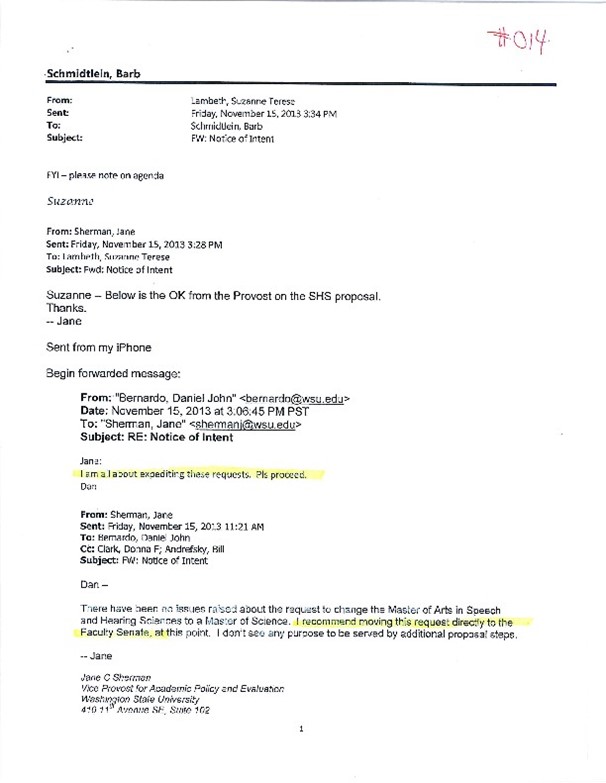
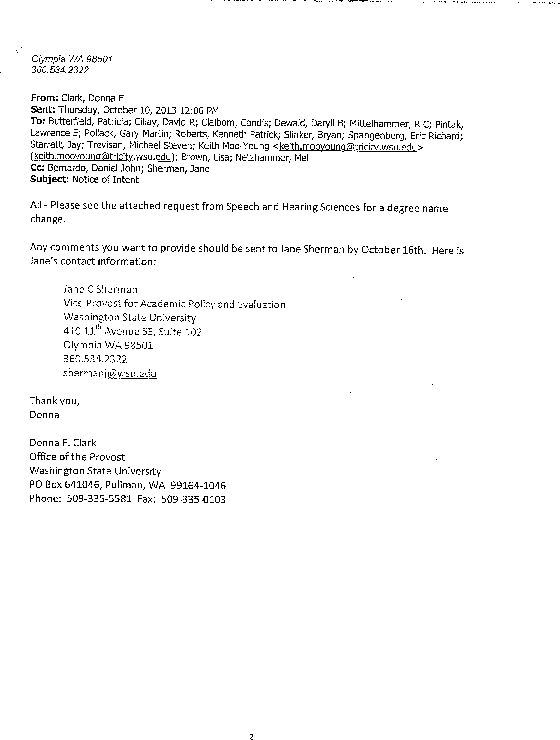
- Recommendation from Graduate Studies Committee the proposal to change their degree in Master of Arts in Speech and Hearing Sciences to Master of Science in Speech and Hearing Sciences (Exhibit W, W1) as follows:
MEMORANDUM
TO: Dorene Branson, Principal Assistant
Faculty Senate
FROM: Graduate Studies Committee DATE: February 19, 2014
SUBJECT: Speech and Hearing Sciences Approval
On Tuesday, February 18th, the Graduate Studies Committee approved the proposal to change their degree in Master of Arts in Speech and Hearing Sciences to Master of Science in Speech and Hearing Sciences. Please forward this to the Faculty Senate for appropriate approvals.
*****MOTION CARRIED
- Recommendation from Graduate Studies Committee on Major Graduate Bulletin #5 (Exhibit E) – J. Yoder
| GRADUATE MAJOR CHANGE BULLETIN NO. 5 Spring 2014 The courses listed below reflect the graduate major curricular changes approved by the Catalog Subcommittee and the Graduate Studies Committee since approval of the last Graduate Major Change Bulletin. All new and revised courses are printed in their entirety under the headings Proposed and Current, respectively. The column to the far right indicates the date each change becomes effective. | |||||
| Subject | Course Number | New Revise Drop | Current | Proposed | Effective Date |
| PREV SCI | 535 | Revise | (H D) Effective Prevention Strategies I 3 Community mobilization and problem analysis; program selection, implementation, and management; grant writing. | 8-14 | |
*****MOTION CARRIED
- Recommendation from Academic Affairs for Undergraduate Major Change Bulletin #8 (Exhibit Y, Y1) as follows:
| UNDERGRADUATE AND PROFESSIONAL MAJOR CHANGE BULLETIN NO. 8 Spring 2014 —COURSES–– The courses listed below reflect the undergraduate major curricular changes approved by the Catalog Subcommittee since approval of the last Undergraduate Major Change Bulletin. All new and revised courses are printed in their entirety under the headings Current and Proposed, respectively. The column to the far right indicates the date each change becomes effective. | |||||
| Subject | Course Number | New Revise Drop | Current | Proposed | Effective Date |
| ANIM SCI | 166 | New | –N/A-– | Young Horse Handling 1 (0-3) Course Prerequisite: ANIM SCI 101. Effective horse handling skills and techniques. Safety for both horse and human will be emphasized and prioritized throughout the course. | 8-14 |
| E E/CPT S | 439 | New | –N/A-– | Critical Infrastructure Security: The Emerging Smart Grid 3 Course Prerequisite: Senior standing. Smart electric grid, communication networks, distributed computing, fault tolerant computing, cyber security, analyzing interdependencies between the smart grid components, smart grid standards and protocols. (Crosslisted course offered as E E 439, CPT S 439) Credit not granted for both E E/CPT S 439 and E E/CPT S 539. Offered at 400 and 500 level. | 8-14 |
| PHARDSCI | 528 | Revise | Pharmacokinetics 3 Course Prerequisite: PHARDSCI 518. Qualitative and quantitative understanding of the processes of drug absorption, distribution, and elimination. | Pharmacokinetics 3 Course Prerequisite: PHARDSCI 518. Qualitative and quantitative understanding of the processes of drug absorption, distribution, and elimination. H, S, F grading. | 8-14 |
| PHARDSCI | 532 | Revise | Integrated Pharmacology III 4 Course Prerequisite: PHARDSCI 512. Immunopharmacology (including immunizations), chemotherapeutics (antibiotics, antivirals, and anti-cancer drugs), and endocrine pharmacology. | Integrated Pharmacology III 4 Course Prerequisite: PHARDSCI 512. Immunopharmacology (including immunizations), chemotherapeutics (antibiotics, antivirals, and anti-cancer drugs), and endocrine pharmacology. H, S, F grading. | 8-14 |
| PHARDSCI | 542 | Revise | Integrated Pharmacology IV 4 Course Prerequisite: PHARDSCI 532. Pharmaceutical biotechnology, basic toxicology, pharmacogenomics and complementary and alternative medicines. | Integrated Pharmacology IV 4 Course Prerequisite: PHARDSCI 532. Pharmaceutical biotechnology, basic toxicology, pharmacogenomics and complementary and alternative medicines. H, S, F grading. | 8-14 |
| PHARMACY | 531 | Revise | Applied Patient Care II: Clinical Assessment and Documentation 1 (0-3) Course Prerequisite: PHARMACY 501. Clinical assessment and documentation skills necessary for effective pharmaceutical care. | Applied Patient Care II: Clinical Assessment and Documentation 1 (0-3) Course Prerequisite: PHARMACY 501. Clinical assessment and documentation skills necessary for effective pharmaceutical care. H, S, F grading. | 8-14 |
| PHARMACY | 533 | Revise | Introductory Pharmacy Practice Experience II 3 (0-9) Course Prerequisite: | Introductory Pharmacy Practice Experience II 3 (0-9) Course Prerequisite: PHARDSCI | 8-14 |
| 512; PHARDSCI 518; PHARDSCI 519; PHARMACY 513; PHARMACY 514; PHARMACY 516. Authentic practice situations and service learning with opportunities for discussion and reflection. H, S, F grading. | |||||
| PHARMACY | 534 | Revise | Pharmacotherapy II 4 Course Prerequisite: | Pharmacotherapy II 4 Course Prerequisite: PHARDSCI 512; concurrent enrollment in PHARDSCI 532; PHARMACY 514. Second in a sequence of courses that focuses on the clinical use of medications in the prevention, mitigation, or cure of disease. H, S, F grading. | 8-14 |
| PHARMACY | 541 | Revise | Applied Patient Care III: Medication Therapy Management 1 (0-3) Course Prerequisite: PHARMACY 531. Identification of pertinent patient findings, assessment of drug- related problems and clinical problem solving. | Applied Patient Care III: Medication Therapy Management 1 (0-3) Course Prerequisite: PHARMACY 531. Identification of pertinent patient findings, assessment of drug- related problems and clinical problem solving. H, S, F grading. | 8-14 |
| PHARMACY | 543 | Revise | Introductory Pharmacy Practice Experience III 1 Course Prerequisite: | Introductory Pharmacy Practice Experience III 1 Course Prerequisite: PHARDSCI 528; PHARDSCI 532; PHARMACY 527; PHARMACY 531; PHARMACY 533; PHARMACY 534. Authentic practice situations and service learning with opportunities for discussion and reflection. H, S, F grading. | 8-14 |
| PHARMACY | 544 | Revise | Pharmacotherapy III 4 Course Prerequisite: PHARMACY 534; concurrent enrollment in PHARDSCI 542. Third in a sequence of courses that focuses on the clinical use of medications in the prevention, mitigation, or cure of disease. | Pharmacotherapy III 4 Course Prerequisite: PHARMACY 534; concurrent enrollment in PHARDSCI 542. Third in a sequence of courses that focuses on the clinical use of medications in the prevention, mitigation, or cure of disease. H, S, F grading. | 8-14 |
| PHARMACY | 545 | Revise | Pharmacy Management 3 | Pharmacy Management 3 | 8-14 |
| Course Prerequisite: Admission to Pharmacy program. Management principles essential for common practice settings in the profession of pharmacy. | Course Prerequisite: Admission to Pharmacy program. Management principles essential for common practice settings in the profession of pharmacy. H, S, F grading. | ||||
| PHARMACY | 551 | Revise | Applied Patient Care IV: Advanced Medication Therapy Management 1 (0-3) Course Prerequisite: PHARMACY 541. Medication therapy management for complex patients; case-based discussions and human patient simulation. | Applied Patient Care IV: Advanced Medication Therapy Management 1 (0-3) Course Prerequisite: PHARMACY 541. Medication therapy management for complex patients; case-based discussions and human patient simulation. H, S, F grading. | 8-14 |
| PHARMACY | 553 | Revise | Introductory Pharmacy Practice Experience IV 3 (0-9) Course Prerequisite: | Introductory Pharmacy Practice Experience IV 3 (0-9) Course Prerequisite: PHARDSCI 542; PHARMACY 541; PHARMACY 543; PHARMACY 544; PHARMACY 546. Authentic practice situations and service learning with opportunities for discussion and reflection. H, S, F grading. | 8-14 |
| PHARMACY | 554 | Revise | Pharmacotherapy IV 4 Course Prerequisite: PHARMACY 544. Fourth in a sequence of courses that focuses on the clinical use of medications in the prevention, mitigation, or cure of disease. | Pharmacotherapy IV 4 Course Prerequisite: PHARMACY 544. Fourth in a sequence of courses that focuses on the clinical use of medications in the prevention, mitigation, or cure of disease. H, S, F grading. | 8-14 |
| PHARMACY | 555 | Revise | Drug Information and Literature Evaluation | Drug Information and Literature Evaluation 4 Course Prerequisite: PHARMACY 544. Evaluation of drug information in pharmaceutical and biomedical literature to provide better patient care. H, S, F grading. | 8-14 |
| PHARMACY | 557 | Revise | Pharmacotherapy V 4 Course Prerequisite: PHARMACY 554. Fifth in a sequence of courses that focuses on the clinical use of medications in the prevention, mitigation, or cure of disease. | Pharmacotherapy V 4 Course Prerequisite: PHARMACY 554. Fifth in a sequence of courses that focuses on the clinical use of medications in the prevention, mitigation, or cure of disease. H, S, F grading. | 8-14 |
| PHARMACY | 558 | Revise | Applied Clinical Pharmacokinetics 2 Course Prerequisite: PHARDSCI 528. Clinical applications of pharmacokinetics including theoretical background and application to patient care. | Applied Clinical Pharmacokinetics 2 Course Prerequisite: PHARDSCI 528. Clinical applications of pharmacokinetics including theoretical background and application to patient care. H, S, F grading. | 8-14 |
| PHARMACY | 559 | Revise | Quality Assurance and Patient Safety 2 Course Prerequisite: Admission to Pharmacy program. Patient safety issues including quality assurance, medication error avoidance and risk management in healthcare systems. | Quality Assurance and Patient Safety 2 Course Prerequisite: Admission to Pharmacy program. Patient safety issues including quality assurance, medication error avoidance and risk management in healthcare systems. H, S, F grading. | 8-14 |
| PHARMACY | 561 | Revise | Applied Patient Care V: Integrated Patient Care 1 (0-3) Course Prerequisite: PHARMACY 551. Integration of pharmaceutical care with an interdisciplinary emphasis using patient cases and human patient simulation. | Applied Patient Care V: Integrated Patient Care 1 (0-3) Course Prerequisite: PHARMACY 551. Integration of pharmaceutical care with an interdisciplinary emphasis using patient cases and human patient simulation. H, S, F grading. | 8-14 |
| PHARMACY | 563 | Revise | Introductory Pharmacy Practice Experience V | Introductory Pharmacy Practice Experience V 2 Course Prerequisite: PHARMACY 551; PHARMACY 553; PHARMACY 554; PHARMACY 555; PHARMACY 558; PHARMACY 559. Authentic practice situations and service learning with opportunities for discussion and reflection. H, S, F grading. | 8-14 |
| PHARMACY | 564 | Revise | Pharmacy Law and Regulatory Affairs 3 Course Prerequisite: Admission to Pharmacy program. Legal and ethical pharmacy practice including licensing, patient privacy protection, order fulfillment and contracts. | Pharmacy Law and Regulatory Affairs 3 Course Prerequisite: Admission to Pharmacy program. Legal and ethical pharmacy practice including licensing, patient privacy protection, order fulfillment and contracts. H, S, F grading. | 8-14 |
| PHARMACY | 565 | Revise | Parenteral Products 2 (0-4) | Parenteral Products 2 (0-4) | 8-14 |
| Course Prerequisite: PHARDSCI 519; PHARMACY 554. Preparation and administration of compounded parenteral products; patient case discussions and student presentations. | Course Prerequisite: PHARDSCI 519; PHARMACY 554. Preparation and administration of compounded parenteral products; patient case discussions and student presentations. H, S, F grading. | ||||
| PHARMACY | 566 | Revise | Therapeutics of Special Populations 3 Course Prerequisite: PHARMACY 554. Special therapeutic needs of unique populations including pediatrics, chronic neurologic disorders, hospice care and immuno-compromised patients. | Therapeutics of Special Populations 3 Course Prerequisite: PHARMACY 554. Special therapeutic needs of unique populations including pediatrics, chronic neurologic disorders, hospice care and immuno-compromised patients. H, S, F grading. | 8-14 |
Note: Exhibit Y1 on Undergraduate Major Change Bulletin #5 Requirements for Spring 2014 is attached as a hardcopy for archived records. Electronic version is attached Y1.
*****MOTION CARRIED
- Recommendation from Academic Affairs for UCORE Bulletin #9 (Exhibit Z ) as follows:
| UNDERGRADUATE UCORE CATEGORY CHANGE BULLETIN NO. 9 SPRING 2014 The courses listed below reflect conversion changes from GER codes to UCORE Categories, changes to established non-GER courses to add UCORE categories, and minor curricular changes as approved by the UCORE Committee and the Catalog Subcommittee. All revised courses are printed in their entirety under the headings Current and Proposed, respectively. The column to the far right indicates the date each change becomes effective. | |||||
| Subject | Course Number | New Revise Drop | Current | Proposed | Effective Date |
| ANIM SCI | 464 | Revise | [M] Companion Animal Management 3 (2-3) Course Prerequisite: Junior standing. Care and management of companion animal species throughout the life cycle, including nutrition, reproduction, exercise and behavior. Cooperative: Open to UI degree-seeking students. | [CAPS] [M] Companion Animal Management 3 (2-3) Course Prerequisite: Junior standing. Principles of management, political, emotional, and financial aspects of pet care and companionship. Problem solving in all aspects of management. Cooperative: Open to UI degree-seeking students. | 8-14 |
| CES | 308 | Revise | [M] Cultural Politics of Sport 3 A critical examination of US | [SSCI] [M] Cultural Politics of Sport 3 A critical examination of | 8-14 |
| sports through class, race, gender, sexuality, nationalism and criminality. | US sports through class, race, gender, sexuality, nationalism and criminality. | ||||
| PHIL | 314 | Revise | [HUM] [M] Philosophies and Religions of India 3 Metaphysical, epistemological, ethical, aesthetic, social, and political views of Hinduism, Buddhism, and Islam, and their influence on Indian civilization. (Crosslisted course offered as PHIL 314, ASIA 314). | 8-14 | |
| PHIL | 315 | Revise | [HUM] [M] Philosophies and Religions of China and Japan 3 The philosophies and religions of China and Japan, and their metaphysical, epistemological, ethical, social, and political positions and views of God and gods. (Crosslisted course offered as PHIL 315, ASIA 315). | 8-14 | |
| PHIL | 370 | Revise | [HUM] Environmental Ethics 3 Explores the obligations we have regarding non-human parts of the environment and the justification for those obligations. | 8-14 |
*****MOTION CARRIED
- Recommendation from Academic Affairs for a new rule 110 (Exhibit B) as follows:
TO: Faculty Senate
FROM: Becky Bitter, Registrar’s Office, for AAC
DATE: 20 February 2014
SUBJECT: Proposal for New Rule 110, Undergraduate University Requirements for Graduation At its meeting on February 19, 2014, AAC approved the following proposal to establish new rule 110.
For many years, the WSU Catalog has included a section in the Summary of Academic Policy chapter which describes the catalog limitations and time restrictions for University and general education requirements. This section now needs to be updated to reflect current practices as well as to reflect proposed changes that will more precisely describe how University and general education requirements will apply to different types of students. In addition, this policy should be codified in the academic regulations which contain other rules governing graduation requirements for undergraduate.
The rule is being proposed by the Provost’s Office, the Office for Undergraduate Education, and the graduations and degree audit area in the Registrar’s Office and has support from the Center for Advising and Career Development.
Rule 110. Undergraduate University Requirements for Graduation
The University requirements for graduation must be satisfied prior to the awarding of an undergraduate degree. Students meet the University requirements for graduation, including general education requirements, as follows:
- New students are held to the University requirements that are published in the catalog with the effective date that corresponds to their Admission term.
- Former students who are readmitted to WSU are held to the University requirements that are published in the catalog at the time they are readmitted and reflect their most current admission term.
- Students who apply to graduate who are not currently enrolled will be held to the University requirements as follows:
- Students applying to graduate through Summer 2016 will be held to the General Education Requirements listed in the 2009 WSU Catalog.
- Students applying to graduate beginning Fall 2016 will be held to the University Core Requirements listed in the 2012 WSU Catalog.
Students who were enrolled at WSU prior to Fall 2012 may petition to fulfill the University requirements based on an earlier set of requirements. All students may request to substitute their University and general education requirements for the most current set of those requirements.
We propose that this rule be effective for Fall 2014. Thank you for your review of this proposal
*****MOTION CARRIED
- Election of Legislative Representative Joan Wu. Bio:
Dr. Joan Wu received her BS in Geology (1986) and MS (1989) in Hydrology from Tongji University in Shanghai. She received her PhD (1994) in Agricultural Engineering from The Ohio State University in Columbus, Ohio, and a MS (2009) in Mathematics from WSU. She is a registered Civil Engineer in the State of Washington. Dr. Wu has been Assistant, Associate, and Professor at WSU since 1998. She has led the continuous development of the USDA’s WEPP (Watershed Erosion Prediction Project) model at WSU and is technically responsible for WEPP releases v2001.3, v2004.7, v2006.5, v2008.4, v2010.1, v2012.8, and v2014.2. WEPP is one of the most widely used water erosion prediction technologies for watershed assessment and management in the US and worldwide.
*****MOTION CARRIED.
Agenda Items. (Discussion Items).
- Recommendation from Graduate Studies Committee on Major Graduate Bulletin #6 (Exhibit G)– J. Yoder Discussion: An inquiry was made asking if all the changes reflected in the bulletin could be done within a single bulletin? It was noted that yes it can be.
- Recommendation from Graduate Studies Committee on changes to the Graduate School Policies and Procedures. These changes involve modifications to existing policies, as well as new, transfer, and electronic signature policies (Exhibits M, M1, M2, M3) – J. Yoder
- Discussion: A concern was made regarding the policy of not transferring graduate level courses taken by undergraduate students as part of their undergraduate degree. It was noted this is not a change; simply a clarification of policy and that exception to this policy can be done on a case by case basis. An additional concern was the practices of having external Faculty sit in during Graduate Exams. It was noted these faculty are trained representatives and are not selected randomly.
- Recommendation from Graduate Studies Committee for moving the Pharmaceutical Sciences MS to the Spokane Campus. (Exhibits O, O1) – J. Yoder
- No Discussion
- Recommendation from Academic Affairs for a proposal to revise Rules 106, 34, 114 and 115 (Exhibit H) – R. Zack
- No Discussion
- Recommendation from Academic Affairs for a proposal to establish a new Rule 111 (Exhibit I) – R. Zack
- No Discussion
- Recommendation from Academic Affairs for Undergraduate Major Change Bulletin #9 ( Exhibits J, J1) – R.Zack
- No Discussion
- Recommendation from Academic Affairs for Undergraduate Major Change Bulletin #10 ( Exhibits K, K1) -R.Zack
- No Discussion
- Recommendation from Academic Affairs for UCORE Bulletin # 10 (Exhibit L) – R.Zack
- No Discussion
- Recommendation from Academic Affairs to approve the proposal to Extend the Bachelor of Science in Electrical Engineering to Everett (Exhibits N, N1, N2) – R. Zack
- Discussion: A concern was raised that it appears that tuition on the new campuses is less than Pullman’s tuition. It was noted that the tuition charged is the same on all campuses; the budget numbers simply reflect the fact that some of the funds go back to the department. An additional concern was raised asking if these new programs would affect enrollment on the Pullman campus. It was noted that a decrease in Pullman enrollment was not anticipated since these programs are meeting a local need. The same concerns were reflected for #10 and #11 discussion items.
- Recommendation from Academic Affairs to approve the proposal to Extend the Bachelor of Arts in Communication to Everett (Exhibits P, P1, P2)-R. Zack
- No additional discussion items (see #9).
- Recommendation from Academic Affairs to approve the proposal to Extend the Bachelor of Arts in Hospitality Business Management to Everett (Exhibits Q, Q1, Q2)- R. Zack
- No additional discussion items noted (see #9).
- Constituents’ Concerns.
- None.
Adjournment.
The meeting adjourned at 4:02 p.m.
Sheila Converse, Executive Secretary
Comments