The Faculty Senate was called to order by Bob Greenberg, Chair Thursday October 25, 2012, in FSHN T101at 3:30 p.m. Twenty-six (26) members were present, eighteen (18) members were absent with six nonvoting present.
Minutes of October 11,2012 Meeting were approved as circulated. Announcements (Information Items)
- R. Greenberg, R. Rosenman, D. Turnbull and D. Branson attended the Coalition of PAC 12 Faculty Leadership meetings in Salt Lake Oct 19-21.
- Minor Change Bulletin#2 is in Exhibit B as follows:
| Prefix | Course Number | New Revise Drop | Current | Proposed | Effective Date |
| AMDT | 368 | Revise | Apparel Illustration and Rendering 3 (0-6) Illustration and rendering used for costume and fashion design. (Crosslisted course offered as AMDT 368, FINE ART 369). | 1-13 | |
| ECONS | 311 | Revise | [M] Introductory Econometrics 3 Course Prerequisite: ECONS 101 or 198; ECONS 102 or | [M] Introductory Econometrics 3 Course Prerequisite: ECONS 101, 102, or 198; STAT 212 or | 8-13 |
| 198; STAT 212 or MGTOP 215; MATH 171 or 202. Methods of empirical analysis in the context of economic analysis and forecasting problems. | MGTOP 215; MATH 171 or 202. Methods of empirical analysis in the context of economic analysis and forecasting problems. | ||||
| FINE ART | 369 | Revise | Apparel Illustration and Rendering 3 (0-6) Illustration and rendering used for costume and fashion design. (Crosslisted course offered as AMDT 368, FINE ART 369). | 1-13 | |
| FS | 416 | Revise | Food Microbiology 3 Course Prerequisite: MBIOS 305; | Food Microbiology 3 Course Prerequisite: MBIOS 304; MBIOS 305. Purpose for enumeration, detection and identification of microorganisms in food products; physical, chemical and environmental factors influencing growth and survival of foodborne microorganisms; pathogenic and spoilage microorganisms in food and their control. Cooperative course taught jointly by WSU and UI (FS 416). | 8-13 |
| FS | 418 | Revise | Oral Seminar in Food Science 1 May be repeated for credit; cumulative maximum 2 hours. Course Prerequisite: Junior standing; certified major in food science. Development of skills and communication tools and techniques for oral | Oral Seminar in Food Science 1 May be repeated for credit; cumulative maximum 2 hours. Course Prerequisite: FS 110 or 220; Junior standing; certified major in food science. Development of skills and communication tools and techniques for oral presentations of current | 8-13 |
| presentations of current food science research. Cooperative course taught jointly by WSU and UI (FS 418). | food science research. Cooperative course taught jointly by WSU and UI (FS 418). | ||||
| FS | 462 | Revise | Food Analysis 3 (2-3) Course Prerequisite: CHEM 345; FS 303; | Food Analysis 3 (2-3) Course Prerequisite: CHEM 345; FS 302; FS 303; senior standing. Introductory food analysis; methods common to many food commodities. Recommended preparation: FS 460; FS 461. Cooperative course taught jointly by WSU and UI (FS 462). | 8-13 |
| FS | 466 | Revise | Wine Microbiology and Processing Laboratory 1 (0-3) Course Prerequisite: FS 465 or concurrent enrollment; MBIOS | Wine Microbiology and Processing Laboratory 1 (0-3) Course Prerequisite: FS 465 or concurrent enrollment; MBIOS 304. Hands-on winemaking; application of chemical microbiological methods for wine analysis. Field trip required. (Crosslisted course offered as FS 466, VIT ENOL 466). Cooperative course taught jointly by WSU and UI (FS 466). | 8-13 |
| FS | 470 | Revise | Advanced Food Technology 3 Course Prerequisite: FS 303. Physical principles of food preservation and recent advances in food technology. Credit not granted for both FS 470 and FS 570. Recommended preparation: FS 416; FS 432; FS 460. Offered at | Advanced Food Technology 3 Course Prerequisite: FS 302; FS 303. Physical principles of food preservation and recent advances in food technology. Credit not granted for both FS 470 and FS 570. Recommended preparation: FS 416; FS 432; FS 460. Offered at 400 and 500 level. Cooperative | 8-13 |
| 400 and 500 level. Cooperative course taught jointly by WSU and UI (FS 470). | course taught jointly by WSU and UI (FS 470). | ||||
| FS | 518 | Revise | Seminar | Oral Seminar 1 May be repeated for credit. Development of skills and communication tools and techniques for oral presentations of current food science research. Cooperative course taught jointly by WSU and UI (FS 518). | 8-13 |
| I_BUS | 581 | Drop | International Finance 3 Course Prerequisite: Admission to the MBA, Master of Accounting, or Business PhD programs. Principles of international finance; financial management of multinational corporations; international investments. (Crosslisted course offered as I BUS 581, FIN 581). | –N/A– | 1-13 |
| MATH | 303 | Revise | [M] | [M] Geometry for the Middle School Teachers 3 Course Prerequisite: MATH 252. Topics in 2D and 3D geometry including technology-based reasoning and exploration, deductive arguments, transformational and proportional reasoning, and non-Euclidean geometries. | 8-13 |
| MSE | 316 | Revise | Thermodynamics and Kinetics of Materials 3 Laws of thermodynamics, solution thermodynamics, free energy composition diagrams, mechanisms and kinetics of diffusion; | 1-13 |
| solidification behavior, interfaces and phase boundaries, phase transformations in solids, oxidation, and corrosion. | |||||
| PHYSICS | 303 | Revise | Modern Physics I 3 Course Prerequisite: MATH 220 or concurrent enrollment or MATH 230 or concurrent enrollment; PHYSICS 202 or 206. Quantum and relativity theories with applications to atomic, solid state, nuclear and elementary particle physics. | Modern Physics I 3 Course Prerequisite: MATH 220 or concurrent enrollment or MATH 230 or concurrent enrollment; PHYSICS 202 or concurrent enrollment or PHYSICS 206 or concurrent enrollment. Quantum and relativity theories with applications to atomic, solid state, nuclear and elementary particle physics. | 1-13 |
| PHYSICS | 533 | Revise | Thermal and Statistical Physics I 3 Thermodynamic laws and potentials, kinetic theory, hydrodynamics and transport coefficients; introduction to statistical mechanics, ensembles, partition functions. | Thermal and Statistical Physics I 3 Thermodynamic laws and potentials, kinetic theory, hydrodynamics and transport coefficients; introduction to statistical mechanics, ensembles, partition functions. | 1-13 |
| SHS | 461 | Clinical Methods 2 (1-3) Course Prerequisite: Concurrent enrollment in SHS 480 or SHS 478. Pre- practicum preparation; observation of and assisting in therapy; state laws; clinical methods. | 1-13 | ||
| SOIL_SCI | 414 | Revise | Environmental Biophysics 2 Physical environment of living | Environmental Biophysics 2 Physical environment of living organisms | 1-13 |
| organisms (temperature, humidity, radiation, wind); heat and mass exchange and balance in plant and animal systems. Recommended preparation: Introductory biology | (temperature, humidity, radiation, wind); heat and mass exchange and balance in plant and animal systems. Recommended preparation: Introductory biology, physics, and calculus. Offered at 400 and 500 level. Cooperative course taught by WSU, open to UI students. | ||||
| SOIL_SCI | 514 | Revise | Environmental Biophysics 2 Physical environment of living organisms (temperature, humidity, radiation, wind); heat and mass exchange and balance in plant and animal systems. Recommended preparation: Introductory biology | Environmental Biophysics 2 Physical environment of living organisms (temperature, humidity, radiation, wind); heat and mass exchange and balance in plant and animal systems. Recommended preparation: Introductory biology, physics, and calculus. Offered at 400 and 500 level. Cooperative course taught by WSU, open to UI students. | 1-13 |
| VIT ENOL | 466 | Revise | Wine Microbiology and Processing Laboratory 1 (0-3) Course Prerequisite: FS 465 or concurrent enrollment; MBIOS | Wine Microbiology and Processing Laboratory 1 (0-3) Course Prerequisite: FS 465 or concurrent enrollment; MBIOS 304. Hands-on winemaking; application of chemical microbiological methods for wine analysis. Field trip required. (Crosslisted course offered as FS 466, VIT ENOL 466). Cooperative course taught jointly by WSU and UI (FS 466). | 8-13 |
Announcements (Reports).
- Remarks by the Chair.—R. Greenberg
- Greenberg reported the site visit for accreditation will be in April. He stated the PAC 12 Faculty Coalition meetings held in Salt Lake were very productive. The group discussed structure and election process. The question was raised about communication with administrators and officers and all agreed WSU had the best practices in that regard. The upcoming 2% pay to all faculty and staff is not salary increase. It is simply a one time payment on December 10. Greenberg urged all faculty to read the President’s perspectives outlining the process.
Additions or Changes to the Agenda.
- There were no additions or changes to the agenda.
Agenda Items. (Action Items)
- Recommendation from Academic Affairs for UCORE Bulletin #1 Exhibit K is as follows:
| UNDERGRADUATE UCORE CATEGORY CHANGE BULLETIN NO. 1 FALL 2012 The courses listed below reflect conversion changes from GER codes to UCORE Categories, changes to established non-GER courses to add UCORE categories, and minor curricular changes as approved by the UCORE Committee and the Catalog Subcommittee. All revised courses are printed in their entirety under the headings Current and Proposed, respectively. The column to the far right indicates the date each change becomes effective. | |||||
| Prefix | Course Number | New Revise Drop | Current | Proposed | Effective Date |
| H_D | 101 | Revise | [SSCI] Human Development Across the Lifespan 3 Overview of lifespan development from a psychosocial ecological perspective; examines individuals, families, organizations, and communities and their interrelationships. | 8-12 | |
| POL_S | 101 | Revise | [SSCI] American National Government 3 Introduction to American politics explores the constitution, political institutions and actors, the policy making process, and various public policies. | 8-12 | |
* * * * *
Motion carried.
- Recommendation from Academic Affairs for Undergraduate and Professional Major Change Bulletin #2 Exhibit L is as follows:
| UNDERGRADUATE AND PROFESSIONAL MAJOR CHANGE BULLETIN NO. 2 Fall 2012 —COURSES— The courses listed below reflect the undergraduate major curricular changes approved by the Catalog Subcommittee since approval of the last Undergraduate Major Change Bulletin. All new and revised courses are printed in their entirety under the headings Current and Proposed, respectively. The column to the far right indicates the date each change becomes effective. | |||||
| Prefix | Course Number | New Revise Drop | Current | Proposed | Effective Date |
| ENGLISH | 102 | Revise | Writing Tutorial | Writing Tutorial 1 (0-3) May be repeated for credit; cumulative maximum 5 hours. Student-centered group tutorial focusing on writing improvement usually connected to the ENGLISH 101 course. S, F grading. | 1-13 |
| ENGLISH | 107 | Revise | Writing Tutorial for | Writing Tutorial for | 1-13 |
| ESL students | ESL students 1 (0-3) | ||||
| May be repeated for | |||||
| repeated for credit; | credit; cumulative | ||||
| cumulative maximum 5 | maximum 5 hours. | ||||
| hours. Student-centered | Student-centered group | ||||
| group tutorial focusing | tutorial focusing on | ||||
| on writing improvement | writing improvement | ||||
| usually connected to the | usually connected to the | ||||
| ENGLISH | ENGLISH 105 course. S, | ||||
| course. S, F grading. | F grading. | ||||
| ENGLISH | 299 | Revise | Writing Tutorial for | Writing Tutorial for | 1-13 |
| Honors Students | Honors Students 1 (0-3) | ||||
| May be repeated for | |||||
| repeated for credit; | credit; cumulative | ||||
| cumulative maximum 5 | maximum 5 hours. | ||||
| hours. Course | Course Prerequisite: | ||||
| Prerequisite: Appropriate | Appropriate Honors | ||||
| Honors College Writing Diagnostic score. Student-centered group tutorial focusing on writing improvement usually connected to the ENGLISH 298 course. S, F grading. | College Writing Diagnostic score. Student-centered group tutorial focusing on writing improvement usually connected to the ENGLISH 298 course. S, F grading. | ||||
| ENGR | 401 | New | –N/A– | Technology Ventures 3 Course Prerequisite: Junior standing. Commercialize ideas, modify an existing product, exploit market opportunities, and create new enterprises. | 1-13 |
| NEUROSCI | 305 | New | –N/A– | Neurons, Genes and Behavior 3 Course Prerequisite: NEUROSCI 301, 302, MBIOS 301, or PSYCH 372. In-depth exploration of the organization of the brain, and how this organization underlies behavior. | 5-13 |
| PHARMACY | 579 | New | –N/A– | Diabetes Prevention 2 Course Prerequisite: PHARMACY 544. Preparation for educating patients in diabetes prevention and promoting health and wellness in the community. S, F grading. | 8-13 |
| SOC | 245 | Revise | [S,D] Sociology of Sport 3 Sociological study of sport in America. | (345) [S,D] Sociology of Sport 3 Sociological study of sport in America. | 1-13 |
UNDERGRADUATE AND PROFESSIONAL MAJOR CHANGE BULLETIN NO.
2
Fall 2012
—REQUIREMENTS––
| The requirements listed below reflect the undergraduate major curricular changes approved by the Catalog Subcommittee since approval of the last Undergraduate Major Change Bulletin. All changes are underlined. Deletions are crossed out. The column to the far right indicates the date each change becomes effective. | ||||
| Department Request | Proposed | Effective Date | ||
| Biological Sciences Revise catalog description to update general degree requirements for all | Candidates for the Bachelor of Science in Biology, the Bachelor of Science in Zoology, or the Bachelor of Science General Studies must fulfill the University and the College of Arts and Sciences requirements for graduation as described elsewhere in this catalog. Honors students complete honors requirements in place of general education | 8-13 | ||
| Biology and Zoology degree programs | requirements. The math and science components of those requirements are fulfilled as part of the departmental requirements below. Other university requirements include 120 total credit hours of which 40 must | |||
| be 300-400-level credits, the writing portfolio, and two writing in the | ||||
| major courses (identified by [M] in the course listings). College | ||||
| requirements include one year of foreign language if two years were not | ||||
| taken in high school. The Schedule of Studies below provides a sample | ||||
| curriculum for each of the degree options offered by the School of | ||||
| Biological Sciences. All Bachelor of Science degree options in Biology | ||||
| and Zoology require a minimum of 19 semester hours of core BIOLOGY | ||||
| courses (BIOLOGY 106, 107, 301, 372 and 405 or 403). An additional | ||||
| 21 semester hours of biological sciences coursework selected in | ||||
| consultation with your biology advisor is required. The 21 semester hours | ||||
| must include 15 upper division credits, six of which must be BIOLOGY | ||||
| taken in residence at WSU. An overall GPA of at least 2.0 must be | ||||
| maintained in all college and departmental requirements. | ||||
| are graded S, F (i.e., 490, 491, 495, 496, 499) may be used toward | ||||
| fulfilling departmental requirements or program options, and no other | ||||
| courses taken S or P | ||||
| requirements or program options. | ||||
| additional minor in any combination of Biology, Zoology, General | ||||
| Biological Sciences or General Medical Sciences. | ||||
| Biological Sciences Revise graduation requirements in | Biology – Pre-Physical Therapy / Pre-Occupatio Pre-Physician’s Assistant Option (120 Hours) | nal Therapy / | 8-13 | |
| Bachelor of Science in Biology, PT/OT/PA | First Year | |||
| First Term | Hours | |||
| Option | ||||
| BIOLOGY 106 [BSCI] | 4 | |||
| CHEM 105 [PSCI] | 4 | |||
| ENGLISH 101 [WRTG] | 3 | |||
| HISTORY 105 [ROOT] | 3 | |||
| Second Term | Hours | |||
| BIOLOGY 107 | 4 | |||
| CHEM 106 | 4 | |||
| Communications [COMM] | 3 | |||
| MATH 140 [QUAN] or 171 [QUAN] | 4 | ||
| Second Year | |||
| First Term | Hours | ||
| BIOLOGY 251 | 4 | ||
| CHEM 345 | 4 | ||
| Diversity [DIVR] | 3 | ||
| PSYCH 105 [SSCI] | 3 | ||
| SOC 101 [SSCI] | 3 | ||
| Second Term | Hours | ||
| BIOLOGY 301 | 4 | ||
| Creative & Professional Arts [ARTS] | 3 | ||
| PHYSICS 101 or 201 | 4 | ||
| PSYCH 361 | 3 | ||
| Complete Writing Portfolio | |||
| Third Year | |||
| First Term | Hours | ||
| BIOLOGY 315 | 4 | ||
| BIOLOGY 393 [M] or 490 [M] | 2 | ||
| Humanities [HUM] | 3 | ||
| PHYSICS 102 or 202 | 4 | ||
| STAT 212, or 412 | 3 or 4 | ||
| Second Term | Hours | ||
| BIOLOGY 220 | 2 | ||
| BIOLOGY 372 [M] | 4 | ||
| H D 101 [SSCI] | 3 | ||
| PHYSICS 102 or 202 | 4 | ||
| PSYCH 333 | 3 | ||
| Program Option Courses or Electives1 | 3 | ||
| Fourth Year | |||
| First Term | Hours | ||
| ENGLISH 402 | 3 | ||
| KINES 380 or MBIOS 303 | 3 or 4 | ||
| PHIL 365 [HUM] | 3 | ||
| Program Option Courses or Electives1 | |||
| Second Term | Hours | ||
| BIOLOGY 405 | 3 | ||
| Integrative Capstone [CAPS] | 3 | ||
| Program Option Courses or Electives1 | |||
| Footnotes 1 A minimum of 4 credits of Biological Science courses should be selected from the following courses or chosen in consultation with an advisor: | |||
| Nutrition and Exercise Physiology Drop minor in Coordinated Program in Dietetics. | 1-13 | ||
| Speech and Hearing Sciences Bachelor of Arts in Speech and Hearing Science: Add certification requirements to degree program description | Speech and Hearing Sciences (121 Hours) Certification Requirements: Given the rigorous nature of the coursework and the need to prepare students for work in a pre-professional role or to prepare them for the competitive demands of applying to graduate school in the discipline, students must meet the following minimum requirements to be eligible to certify a major in Speech and Hearing Sciences: 1) Have earned a minimum of 24 credits of undergraduate credits; 2)Have taken, or currently enrolled in, SHS 205, Introduction to | 8-13 | |
| Speech-Language Pathology & Audiology; 3)minimum cumulative GPA of 2.75. At least 45 of the total hours required for the bachelor’s degree in this program must be in 300-400-level courses. Successful completion of SHS 473 and 478 fulfills the university requirement of two writing in the major courses, designated [M]. |
* * * * *
Motion carried.
- Recommendation from Graduate Studies for Graduate Major Change Bulletin #1 Exhibit M is as follows:
| GRADUATE MAJOR CHANGE BULLETIN NO. 1 Fall 2012 The courses listed below reflect the graduate major curricular changes approved by the Catalog Subcommittee and the Graduate Studies Committee since approval of the last Graduate Major Change Bulletin. All new and revised courses are printed in their entirety under the headings Proposed and Current, respectively. The column to the far right indicates the date each change becomes effective. | |||||
| Unit/Subject | Course Number | New Revise Drop | Current | Proposed | Effective Date |
| AS | 501 | New | N/A | Milk, Meat and Methane: Contemporary Animal Production Issues: 3 credits. Graduate-level course will provide knowledge and understanding of livestock issues that affect contemporary livestock production. | 8-2013 |
| ChE/ME | 527 | Revise | Macroscopic Thermodynamics: 3 credits. Advanced thermodynamics from macroscopic viewpoint; basic postulates, equilibrium, stability, property relations, application to thermal-fluid and solid mechanics; irreversible thermodynamics. (Crosslisted Course offered as ME 527, ChE 527). Cooperatively taught jointly by WSU and UI (ME 527 ChE 527) | Macroscopic Thermodynamics: 3 credits. Advanced thermodynamics from macroscopic viewpoint; basic postulates, equilibrium, stability, property relations, application to thermal-fluid and solid mechanics; irreversible thermodynamics. Cooperatively taught jointly by WSU and UI (ChE 527) | 1-2013 |
| CoPsy | 596 | New | N/A | Pet Loss and Human Bereavement: 1 credit course. Addressing human bereavement and grief in the context of the human/animal relationship. | 8-2013 |
| ESRP | 540 | New | N/A | Agroecology: 3 credits. Social and ecological aspects of agriculture and | 1-2013 |
| human food systems. Temporary course | |||||
| FS | 538 | New | N/A | Physical Properties of Food: 2 credit course: Thermophysical behavior of foods and biopolymers, including water transport/activity, rheological, thermal, dielectric, and barrier properties. Newtonian and non- Newtonian flow; Viscous, viscoelastic, and Hookean behavior. Relationship between rheology of food biopolymers and structure, composition, temperature, and plasticizer content. | 8-2013 |
| MBioS | 583 | New | N/A | Professional Skills Seminar: 1 credit. The course covers many aspects of professionalism, including professional behavior, professional dress, and professional sensitivity in social settings | 1-2013 |
| NEP | 600 | New | N/A | Special Projects or Independent Study: variable credit | 1-2013 |
| PharmSci/NEP | 577 | Revise | Introduction to Research: 3 credits | Introduction to Research: 3 credits, crosslist with NEP. | 1-2013 |
| PharmSci/NEP | 597 | Revise | Pharmacology and Toxicology Seminar: 1 credit. | College of Pharmacy Graduate Seminar: 1 credit. Includes NEP graduate students, S,F grading, cooperative listing with UI (VS 597) | 1-2013 |
| PREV_SCI | 700 | New | N/A | Master’s Research, Thesis, and/or Examination: variable credit. Course credit for involvement in M.A. thesis research in Prevention Science program | 1-2013 |
| PREV_SCI | 800 | New | N/A | Doctoral Research, Thesis, and/or Examination: variable credit. Course credit for involvement in Ph.D research in Prevention Science program | 1-2013 |
* * * * *
Motion carried.
- Recommendation from Graduate Studies for the New Prefix Prev Sci for the Prevention Science doctoral program Exhibit N is as follows:
Memorandum
TO: Dorene Branson, Principal Assistant-Faculty Senate
FROM: Graduate Studies Committee
DATE: 28, September, 2012
SUBJECT: Prevention Science Doctoral Program
On Friday, September 28, the Graduate Studies Committee approved the creation of the prefix Prev_Sci for the interdisciplinary Prevention Science doctoral program.
* * * * *
Motion carried.
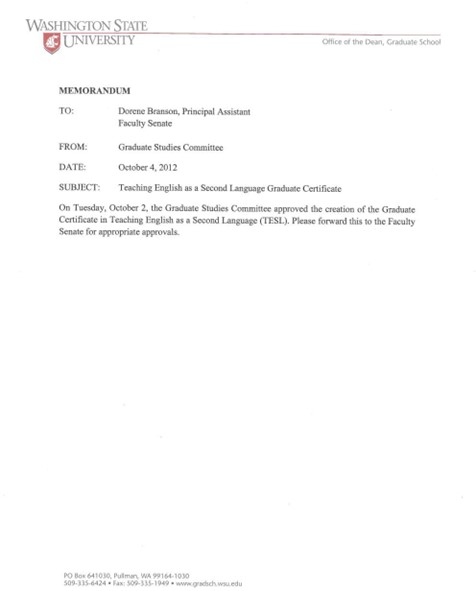
- Recommendation from Graduate Studies for a Graduate Certificate in Teaching English as a Second Language (TESL) Exhibit is as follows:
* * * * *
Motion carried.
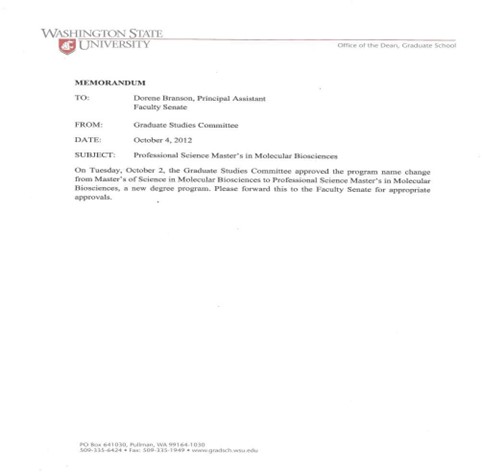
- Recommendation from Graduate Studies for the Name Change in MS in Molecular Bioscience to the Professional Science Master’s in Molecular Bioscience Exhibit is as follows:
RECEIVED MAR 2 8 2012 WSU
REGISTRAR
Washington
State University
MAJOR CHANGE FORM·· REQUIREMENTS
(Submit original signed form and TEN copies to the Registrar’s Office, zip
See https://www.ronet.wsu.edu/ROPubs/Apps/HomePage.ASP for this form.
5.)
•submit an additional copy to the Faculty Senate Office, French Administration 338, zip 1038.
Department Name School of Molecular Biosciences ( SMB)
1. CHECK PROPOSED CHANGES.
*M Change department/program name from M.S. in MBioS (PSM)
lo PSM in MBioS
* New degree or program fn_P_SM_1n_M_o_1ee<i_1a_cB_io_sc_ie_nc_e_s _
•□Change name of degree.from _ lo _
*□Drop degree or program in
•□ Extend existing degree or program to campus
D New Majorin. _
0Change name of Major from lo _
0Revise Major requirements in _ DDrop Majo in D Revise certification requirements for the Major in
DNew Option in _
0Revise requirements for the Option in _

 D Drop Option i” ‘
0New Minor in _
0Revise Minor requirements in _ 0Drop Minor in _
0 New Undergraduate Certificate in _
0 Revise Undergraduate Certificate requirements in _
0Drop Undergraduate Certificate in _
 0Other
Effective term/yea F \1 Z:.D/3

Norah McCabe 335-1134 nrrriccabe@vetmed.wsu.edu
SHAPE \* MERGEFORMAT
Contact Person Contact Phone No. Contact email
2. GIVE REASONS FOR EACH REQUEST MARKED ABOVE. (Attach additional paper if necessary; see reverse side.) see Attached
|
General Education Com/date |
Catalog Subcom/date Academic Affairs Com/date Graduate Studies Com/date Senate/Date
WASHINGTON STATE
‘lJNIVERSITY
Engineering Management
Program College of Engineering and Architecture
To: Norah R. McCabe, Asst. Dean The Graduate School
From: John Ringo, Director
Engineering and Technology Management Date: March 5, 2012
Re: Degree Change for PSM in MBioS
I am pleased to lend support to the request for a name change by the School of Molecular Biosciences (SMB) that will establish a new degree title named “Professional Science Master’s in Molecular Biosciences“. The PSM program
curriculum identifies coursework from the ETM program which we are glad to continue to provide just as we have for the previously named degree.

John Ringo, Director
Engineering and Technology Management
.cc Candis Claiborn, Dean
College of Engineering and Architecture
PO Bo,c 642780, Pullman, WA 99164 2780
509–335-5595 • Foxe 509-335-7290
WASHINGTON
HIGHER
EDUCATION
COORDINAl’ING BOARD
Form 11 Moderate Degree Change Proposal Questionnaire
PART A Fundamental Information Required for all Moderate Degree Change Proposals
1 Institution Name: WASHINGTON STATE UNIVERSl1Y
2 Institutional Endorsement of Moderate Degree Change Proposal by Chief Academic Officer


Endorsement by Chief Academic Officer (Signature) Date
Print Name and Title Warrick M. Bayly, Ph,D., Provost and Executive Vice President for
mlcAffairs
3 Contact Information (Academic Department Representative): Name: McCabe, Norah R.
Title: Assistant Dean. The Graduate School; Djrector, PSM Program Address: French Administration 3241, Pullman, WA 99164
E-mail: nrmccabe@vetmed.wsu.edu Telephone: 509-335-1134
Fax: 509-335-1949
4 Degree Title Change:
Current title (pre-change): Proposed title (post-<:hange):
Start date(s) for new degree(s):
End date(s) for old degree(s):
Master of Science, Mole<:ular Biosciences- PSM option Professional Science Master’s In Molecular Biosciences
Fall Semester 2012 Summer Session 2012
Note: the degree title consists of three elements: level, type, and major. For example, a BA In
Psychology is a bachelor (level) of arts (type) degree In Psychology (major).
S Type of Change Requested (Check One):
!El Conversion of eligible options, specializations, or concentrations into degrees
0 Consolidation of two or more eligible degrees into a single new degree Change in level of an eligible program’s degree designation
0 Other (describe):
Note: “Other” changes need to be accompanied by a formal written exception request.
Form 11 Moderate Degree Change Proposal Questionnaire Page 2 of 15
6 Rationale for Treatment of Change as a Moderate Degree Change
Why should the proposed degree change be categorized as a moderate degree change rather than a change requiring a full proposal for a new degree program?
This change has been approved by the School of Molecular Biosciences (5MB), which Is the home department, The Graduate School and the Faculty Senate. The current program Is in its second year of successful existence as an option within the Master’s program offered by SMB, but current students are requesting the solid recognition that this Is a Professional Science Master’s (PSM) degree rather than an option. In addition, the current optlon has been recognized and accredited as a PSM by the Council of Graduate Schools (CGSI and Is listed as such by the National Professional Science Master’s Association (NPSMA). Finally, the program has been successful in obtaining funding from the Alfred P. Sloan Foundation, based upon Its academic quality and rigor and the potential to secure additional external funding. The upgrade of the current program to a PSM degree, and the subsequent marketing as such is expected to result in enrollment growth to support the demand for such trained Individuals by employers.
7 Accreditation
7a. What kind(s) of program-specific accreditation are available?
Accreditation/affiliation Is available from the CGS and NPSMA, and as the current optlon has received this designation, the proposed upgrade to a PSM degree wll1 likely also receive accreditation.
7b. What program-specific accreditation has been obtained or will be obtained, and when7 See 7A-we will seek accreditation/affiliation from CGS/NPSMA for the proposed changes.
(If program-specific accreditation is available but will not be obtained. explain.) 7c. How will the proposed program change affect program-specific accreditation?
(For example, will the program’s accreditation change? Will the program change allow the program to retain its existing accreditation?)
The program-specific accreditation will not change; however, the program will be designated a PSM degree.
8. Other Basic Information
Sa Will the degree-granting unit change?
0 Yes IRl No
Form 11 Moderate Degree Change Proposal Questionnaire Page 3 of 15
If yes, what are the old and new degree-granting unit names?
If no, what is the ongoing name?
School of Molecular Biosciences Sb Will the CIP code change?
Yes IBl No
If yes, Identify old and new CIP cod,
If no, identify ongoing CIP code: Biosciences: 26.0613
Be Concentrations, options, or specializations
0 Will not change
IBJ Will change as follows: This program will nowbe a degree, not an option.
8d Location(s) and mode[s) of delivery (check one):
IBl Will not change
0 Will change as follows:
NOTE: Changes in location or addition of distance delivery must be accompanied by a Location Notification of Intent (LNOI).
Se Scheduling (day, evening, weekend) and attendance options (full-time, part-time):
IBl Will not change
0 Will change as follows:
Sf Have any of the programs involved in the change been involved in previous MDCPs? (Moderate Degree Change Proposals)
If yes, which programs, which MDCPs, and when?
0 Yes IBl No
8. Short Form Questions for Externally Mandated Changes
9a 0 Yes IBl No The institution certifies that the proposed change Is
mandated by an external accrediting, licensing, or other regulatory authority and that the proposed change will not affect the program’s degree level, curriculum, or faculty, and will not have an adverse impact on any student’s
Form 11Moderate Degree Change Proposal Questionnaire Page 4 of 15
learning eKperience.
If yes, describe the mandate and state its effective date:
SHAPE \* MERGEFORMAT
9b 0 Yes [g] No !For changes In degree level only.) Is the change in degree level externally mandated? PARTB Additional Information ReQuired for Certain Proposals Important Instruction: For
the sake of
flexibility, the HECB w/11 allow
Institutions the option of responding to Part B questions either by filling out the
questionnaire completely, ar
by addressing the “yes or na• components of the Part B questions within the questionnaire form itself and addressing the other informotional requirements by attaching a unified narrative response. If the
institution chooses the unified
narrative response approach, it must st/II submit Part 8 of the questionnaire, with answers to all “yes or no” questions clearly Indicated. · For questions requiring more than just a “yes or na” answer, the institution
may elaborate in an attached unified narrative response, rather thon in the body of Part 8 of the questionnaire. All such narrative elaboration must be crass-referenced to specific questions In the questionnaire. Far example, an
institution electing to
use the unified narrative
response approach would fill out question #14c by checking “yes” and making a cross-reference statement such as “See narrative, page 5, · paragraphs one and two.• Important Instruction: If the
answer to question #9b Is yes, then Port 8 question #10 Is optional. If the onswer to question 119b is no, then
Part B question 1110 Is required. Port B questions #11-16 are required in both cases. Important Instruction: If the onswer to question #9a is yes, answer question 9a and skip the rest of the questionnaire, including #9b and all of Part 8. The intent here is to capture,
as simply as possible, externally mandated changes requiring a stand-alone deoree or new
title, but not
o change in degree level.
10 Rationale for Change
Provide a rationale for making the proposed change at the proposed time, including:
• An overview describing the proposed change Iincluding what is changing and why).
• A history of relevant, existing, pre-change programs and a description of how they have evolved over time.
form 11 Moderate Degree Change Proposal Questionnaire Page 5 of 15
• A description of how the change will benefit students and employers in the changing workplace.
• A description of the community need for the proposed moderate degree change.
• A description of how the proposed change will align with or help Implement the Statewide Strategic Master Plan for Higher Education.
The following presents a rationale for making the proposed changes to the Professional Science Master’s {PSM) program at the proposed time. Included Is an overview of the change, a history of relevant programs, a description of the potential benefits of such a change, address of community need, and a description of the proposed change which Is in alignment with the Statewide Strategic Master Plan for Higher Education.
The proposed change is the elevation of the current PSM option within the Masters’ programs in Molecular Biosciences to that of a Professional Science Master’s degree In Molecular Biosciences. This change moderately alters the program designation, and clarifies that the program is a Professional Science Master’s degree.
The existing PSM option In Molecular Biosciences offered both on the Pullman campus and via WSU online evolved from the Non-Thesis option within the existing MS Program in Molecular Biosciences. Employers and potential employers of science graduates nationwide have articulated a need for employees who are trained in interdlsclpllnary skills – I.e., trained in a science-specific dlsclpllne coupled with training in professional skills, including skllls necessary for efficient and effective transition Into the rapidly changing workplace. In addition, students who earn this degree will compl te a workplace-based Internship. All of these components are found in PSM degrees, which came to prominence in the United States In 1997. Since that time, PSM degrees have been designed, established, and accredited nationally and lntematlonally, with discipline-specific courses in STEM fields. Currently there are over 250 PSM degrees offered at over 150 different institutions. These PSM .programs support the training and
retention of students in many different STEM career tracks, both traditional and non-traditional. In particular the development of PSMs has also expanded the employment and advancement opportunities for science graduates who wish to pursue non–academic and non-traditional
STEM careers.
This degree change provides a signifieant benefit to present and future students and employers, in that a clearly-identified PSM degree assures potential employers of both the specificity a d the breadth of training earned by the program graduates. Baccalaureate science graduates working In their fields are among the lowest-earning college graduates. They need the Incentive and opportunity to further develop their undergraduate science training and utilize it for profitable employment with career advancement opportunities. In addition, the establishment of a PSM degree at WSU will allow access to increased funding opportunities
generated by technical and professional training grants provided by such entities as the National Science Foundation, the Alfred P. Sloan foundation for example, and the Department of Labor. National Interest Is also demonstrated by Congressional action that has recently (2009) allocated
$15 million to the National Science Foundation specifically for Science Master’s program development.
Finally, the proposed change will benefit the Washington Statewide Strategic Master Plan for Higher Education. The development of a PSM degree (the fi t in Washington State), aligns well with the economic, employment and commerce goals of the Plan with Its commitment to supporting economic growth and progress throughout the state, In particular in reference to graduating more citizens with graduate degrees. Also, as the degree can be earned either
* * * * *
Motion carried.
- Recommendation from Steering Committee for Composition Changes to the Graduate Studies Committee Exhibit Q is as follows:\
Functions:
- On a continuous basis, reviews and appraises graduate educational policies, programs, and procedures.
- Recommends establishment, continuation, modification, and termination of graduate courses and degree programs.
Establishes criteria for election to the Graduate Faculty.- Advises the Dean of the Graduate School.
- Makes policy recommendations regarding the granting of graduate scholarships, assistantships, and fellowships, and administers the graduate student travel fund.
- Consults with the Academic Affairs Committee on those policies and procedures which jointly affect graduate and undergraduate education.
- Consults with the Research and Arts Committee on Centers, Institutes and Laboratories on those policies and procedures which affect graduate education.
Composition and Tenure:
- Fourteen members of the Graduate Faculty. Every ollege offering a graduate degree will have
leastoneand no more than tworepresentative:- Comment [RR1]: Saying it this way avoids having to update the committee statement if colleges are reconfigured, and removes colleges like the honors college that offers no graduate degree,
- Current colleges with representatives:
- Agricultural, Human, and Natural Resource Sciences Arts and Sciences
- Business
- Communication
- Education
- Engineering and Architecture
- Nursing
- Pharmacy
- Veterinary Medicine
At least two shall be members of the Senate. (F)FiveThree graduate students, with two-year terms, with one student representing a branch campus. (G)- President, Graduate and Professional Student Association; Dean of the Graduate School, serving as secretary; Provost and Executive Vice President or designee; Chancellor, WSU Spokane; Chancellor, WSU Tri-Cities; Chancellor, WSU Vancouver. (X)(#)
- Comment [RR2]: Why? Spokane makes sense because it is primarily a graduate campus.
- Chair elected by the Committee.
- Permanent Subcommittee: Catalog Subcommittee
- Reports to: Faculty Senate; the President, Dean of the Graduate School, and the Provost and Executive Vice President
* * * * *
Motion carried.
Agenda Items. (Discussion Items).
- Recommendation from Graduate Studies for Graduate Major Change Bulletin #2 (Exhibit R).—P. David
- No discussion.
- Recommendation from Graduate Studies for the Removal of the Graduate Certificate in General Engineering Management (Exhibit S).—P. David
- No discussion.
- Recommendation from Academic Affairs for Undergraduate and Professional Major Change Bulletin #3 (Exhibit T).—C. Parks
- No discussion.
- Recommendation from Academic Affairs for UCORE Bulletin #2 (Exhibit U).—C. Parks
- No discussion.
- Recommendation from Research and Arts for the Mestizo and Indigenous Center for Research and Outreach (Exhibit V).—E. Austin
- Is this center strong in advocacy, but not strong in scholarship? Comparison of stats, role of researchers as objective rather than analytical? Health issues are a concern, pseudo concerns
- Answer, yes scholars are/will be invited to participate in this. Gave update on cultural differences, medical services, approaches to be cultural appropriate for treatment.
Constituents’ Concerns.
In regards again to #5, still had concerns, ask as university, ask what kind of scholar, real rigors? But is this the approach of the university, goal with the relationship of this center? Seems okay to main part, can’t read appdnx A, seems reasonable, can get rid of appndx A? Need to embrace beyond and look for alternative ways of science, so need to expand. Role of research to reflect diversity and appnx A is statement of difference. Chair of committee stated the committee does have representation of various colleges, by sending forward to FS, we do feel comfortable and center will be doing scholarships, grant proposals, etc and committee recommends it.
2 % increase discussion. Need to make it clear this is internally funded that this is a one time increase.
Adjournment.
Adjourned at 4:00 p.m.
Dorene Branson Secretary Pro Tem
Comments