The Faculty Senate was called to order by Bob Greenberg, Chair, on Thursday October 11, 2012, in FSHN T101at 3:30 p.m. Twenty-six (26) members were present, seventeen (17) were absent with nine (9) vacancies. Nine (9) non-voting members were present.
Minutes of September 27, 2012 were approved.
Announcements (Information Items)
- R. Greenberg attended the Regents meetings in Vancouver on October 5.
Announcements (Reports).
- Remarks by the Chair.—R. Greenberg
- Greenberg announced the Senate office will be closed on Friday October 19, 2012 while the officers along with D. Branson will be attending the Coalition of PAC 12 Faculty Senate Leadership Conference in Salt Lake City. Greenberg encouraged all senators to attend the President’s State of the University Address on October 17 at 4:10 in the Bryan Hall auditorium.
Additions or Changes to the Agenda.
- There were no additions or changes to the agenda.
Agenda Items (Action Items)
- Recommendation from Graduate Studies for the Name Change of the PhD in Developmental Science and Prevention to the PhD in Prevention Science Exhibit D is as follows:
- MEMORANDUM
- TO: Dorene Branson, Principal Assistant – Faculty Senate
- FROM: Stergios Fotopoulos, Chair – Graduate Studies Committee
- DATE: October 27, 2011
- SUBJECT: Program Name ChangeOn Tuesday, October 25th the Graduate Studies Committee approved the name change for the program formerly known as the PhD in Developmental Science and Prevention to the name Prevention Science.
- * * * * *
- Motion carried.
- Recommendations from Graduate Studies for the Revisions to Rules 90, 100 and 102 Exhibit E is as follows:
\ \SIII GTD:–:- ‘Ti\11’.
f/JlJ.\’IV1′.RSlTY
Mtl\t{)KANJ)ll l
 TO:
TO:
FROM:
 l),\TF.:
 1’ruµv ;1I to revise Rule 90, Gmc’. :11′,d CrMI(·•P1)i.n.h; HLll(:’l’Jli. G:aC:e l’c•int $y)ttr.1; and Ru.-e ‘102. Sll!dt’.’n. \ Sdu,1:,,lic: Av,·rn};c.·
TI1c t)1ad1,,.ah .S<:livuJ is Ii”lisC1 its{.irac.tuate S<:hool P –.l!<‘i<‘ a1:<1Prot<·<lu:·<.·
Ma ·1u;il. Orw ;1::.pn;: rJi :his1 vhior.. lhe cri: Lhw. of a “t :” (11mwI i. f;u:tmy; p.rndt· fer 700, 702. a:ul Ct) nl’dit , .:t!:t’ ,::ts Rule 9•). Gcad..:s CH’.d Cra1h: 1•r,i11!:.; 1 ·.1h‘! 1(10, Gl.:•de Pol!ll 5yst::1n: am’. ituk 102, Stu\h:U‘s Scholastic 1‘.V<‘:rag . T11<: pr-:)p,:-sc·d dn:nr, nr,t<:d hd 1·1• <an1n1t(•ly :··1.:Uec s the rec.enUy submi•.:1 d .ind appmvrx:d1;;r·1?.I.“>to
g, de (eq.1ir-::m ub for 700. 702.1 md 800 le l !C<IJLS fot g1.t(h.-C.h::-.111<h‘11;s. l, ct.’py of Ill.:: 1..::‘-iSCct &tf.ll’lll(IH! po.icy ili atnched. Tl”.(:“ollo ,klf hO’:’-“ tht r<.·visk,n to th
n:.k, ;11111 i:-.i II iJ< n.:rd<•:r:-<:e ‘.ith u·,.,epp1(.,i,”eddl:1nge 11) ll11: p, 1lky. Pk·<•’><.’ note ttu1t
the· llr;1d1:1k Shuli(J-!>Cormnitte<:ie.:vlev.- d anC. aJ>L)n)•.’.::d t ·1i,; ct1;111gl’ 1>n li bni H:y 14, 2fHZ, and a_g· n11vu S<:>;Jt mt>er 11. 2012. :\n C’Mli\°:I’ •n<:n’,) sir,nN1 by How:m.1 Cr1iff.\ S w,1’i.,;\·nt to t.1<:r’ nllt}’ Senz.le Office !01 rnit·v, in lale T-‘l’1T\rnry. IJ\lt no
aclif1f1 ‘,\’ :- .akcP.

Ct: Julj;, l’<.’lll [t’Uk, Re.gi$trar
n\ ::…y Hit:t:r. Sr…… $iStJint Reg’ls11a1

? ) !”>::,•. i: ,,,,,.,11n n, w:..:; rt,:.1..1(1}0
.SC-? Jb ..111 • •;,►·,,;:\’.tJ•,.l ‘J4!; • ,..,,w:.,,;1,1\J,1.• ..-, v. :fo
GRADES AND GRADE POINTS
90.GRADES AND GRADE POINTS
Washington State University uses letter grades and the four (4) point maximum grading scale. The grade A is the highest possible grade, and grades below Dare considered failing. Plus(+) or minus(-) symbols are used to indicate grades that fall above or below the letter grades, but grades of A+ Jnd D are not used. For purposes of calculating grade points and averages, the plus(+) is equJI to .3 and minus(-) equals .7 (e.g., a grade B+ is equivalent to 3.3 and A– is 3.7). A student’s work is normally rated in accordance with the following definitions:
90rt. A. Student work demonstrates consistently excellent scholastic performance; thorough comprehension; ability to correlate the material with other ideas, to communicate and to deal effectively with course concepts and new material; reliability in attendance and attention lo assignments.
90b. B. Student work demonstrates superior scholastic performance overall, reliability in attendance, and attention to assignments; may demonstrate excellence but be less consistent than the work of an A student.
90c. C. Student work demonstrates satisfactory performance overall, as well as reliability in
attendance, rind attention to assignments.
90d. D. Student work demonstrates minimal, barely passing performance overall; limited knowledge of subject matter.
90e. F. Student work demonstrates unsatisfactory performance and comprehension or unfulfilled requirements. The grade is failing.
90f. S. (Satisfactory.) Grade given upon satisfactory completion of courses numbered 499,600, 700, 702,800·,special examinations (Rule 15) and other courses duly authorized for S, F grading by the Faculty Senate. (Courses approved for S, F grading arc footnoted in the Schedules of Classes.) A, S, or f- grades only are used to report physical education activity grades. S, M (marginally satisfactory), F grades only are used to report grades for designated courses within the College of Veterinary Medicine Courses approved for S, F grading mr1y also be graded Sat midsemester indicating satisfactory progress.
90g. P. (Passing.) A satisfactory grade for a course taken under the pass, fail Grading Option.
Instructors will turn in regular letter grades for all students enrolled in courses under the pass, fail option but grades will appear on the student‘spermanent record as P (Passing) or F (Failure).
90h. I. (Incomplete.) The term is used to indicate that a grade has been deferred. It is for students
wno 1or reasons l)cyond their control are unable to complete their work on time. All outstanding incomplete work (including grades of I, X, and blank/no grade} must be completed and posted to the official transcript prior to the conferral of the undergraduate or professional degree. It is strongly recommended that students who are granted an Incomplete limit their total number of credits to 18 credits (including credits for the Incomplete course and any new courses) during the semester when they are finishing an Incomplete. Undergraduate or graduate students who receive an I grade in an undergraduate course (100-499) have up to the end of the ensuing year to complete the course, unless a shorter interval is specified by the instructor. If the incomplete is not made up during the specified time or tl,e student repeats the course, the I is changed to an F. (See Rule 34.) Faculty are required to submit an Incomplete Grade Report (IGR} to the departmental office with every I given. The IGRmust specify conditions and requirements for completing the incomplete, as well as any time limitations less than one year.
90i. W. This is the term to be used if the student has filed, in the Registrar’s Office, official notice of a withdrawal from the course prior to the end of the 9th week, or withdrew passing in accordance with Rule 69, or withdrew from the university in accordance with Rule 70.
 90j. X. Denotes continuing progress
toward completion of special problems, research, thesis, doctoral dissertation (i.e., 499, 600, 700, 702, 800), or flexible
enrollment
courses; X grades
are converted to S or to a letter grade upon satisfactory completion. All outstanding incomplete work (including
grades of I, X, and blank/no grade) must be completed and posted to the official transcript prior to the conferral of the undergraduate or professional degree. An X grade may also be used when no final grade is reported due to instructor’s illness or absence.
90j. X. Denotes continuing progress
toward completion of special problems, research, thesis, doctoral dissertation (i.e., 499, 600, 700, 702, 800), or flexible
enrollment
courses; X grades
are converted to S or to a letter grade upon satisfactory completion. All outstanding incomplete work (including
grades of I, X, and blank/no grade) must be completed and posted to the official transcript prior to the conferral of the undergraduate or professional degree. An X grade may also be used when no final grade is reported due to instructor’s illness or absence.
90k. U. (Unsatisfactory.} Student work demonstrates unsatisfactory performance, failed examination, or unfulfilled requirements in cour:.es numbered 700, 702, <‘Ind 800.
100. GRADE POINT SYSTEM
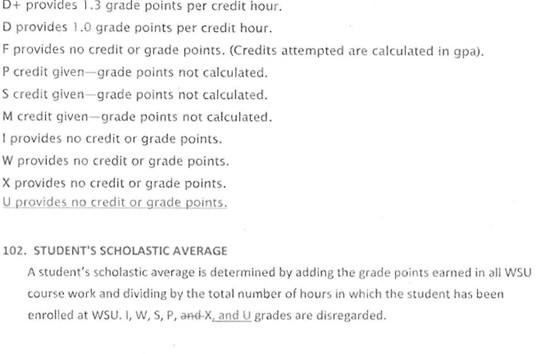
A provides 4.0 grade points per credit hour. A- provi(ies 3.7 grade points per credit hour. B+ provides 3.3 grade points per credit hour.
B provides 3.0 grade points per credit hour. 8–provides 2.7 grade points per credit hour.
C+ provides 2.3 grade points per credit hour. C provides 2.0 grade points per credit hour. C-provides I. 7 grade points per credit hour.
* * * * *
Motion carried.
- Recommendation from Graduate Studies for a New Option in Food Science and Management Within the MS in Agriculture Program Exhibit F is as follows:
WASHINGTON STATE
“lJNIVERSITY Office of the Dean, Graduate School
MEMORANDUM
TO: Kenneth Struckmeyer, Executive Secretary, Faculty Senate
FROM:
DATE: SUBJECT:
Prabu David, Chair Graduate Studies Committee
September 13, 2012
Proposal to Add New Option in Food Science and Management within the MS in Agriculture Program
The Graduate Studies Committee met on September 11, 2012 to vote on the proposed M.S. in Agriculture program. The committee voted unanimously to approve the new option in Food Science and Management within the MS in Agriculture program.
cc: Dorene Branson, Principal Assistant – Faculty Senate Attachment: Major Change Form – Master of Science in Agriculture
PO Box 641030, Pullman, WA 99164-1030
509-335-6424 • Fax: 509-335-1949 • www.gradsch.wsu.edu
While six of the 10 largest schools conferring Agriculture Master‘s
Degrees offer online programs; the online market is far from saturated. Only three schools in Eduventures’ list of online active schools have Agriculture programs and only one, Kansas State University, has an online program that can clearly be identified as Agribusiness.
1. NEEDS ASSESSMENT
Projected Number of Students and Degrees
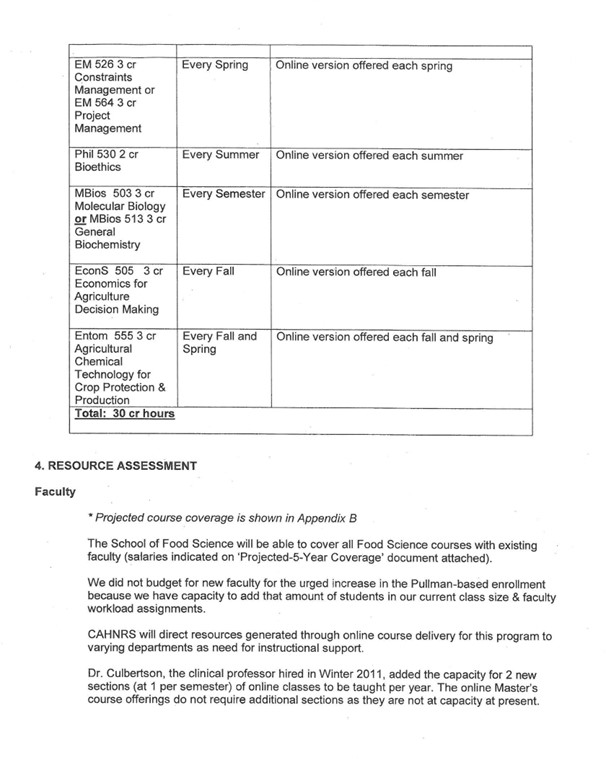
It is difficult to anticipate the enrollment numbers for Fall 2012, as marketing and promotional efforts are on “hold” pending approval of the extension of the current online MS in Ag degree with a new program in Food Science and Management. As soon as approval is received, promotional efforts will commence and ideally applications will be accepted beginning March 2012. Given the market analysis, we do expect the program will grow very quickly. Dr. Jeff Culbertson, a faculty member who has worked in the food industry with the Kellogg Corporation and who has had extensive consulting experience within the food industry and who currently offers an online training certificate in Food Science has had over 50 telephone calls and other contacts since January 2, 2012 inquiring about the start date of an MS in Ag: Food Science and Management degree at WSU. In the food industry, the MS is a gatekeeper degree. Individuals with just a BS are limited in their growth and promotion opportunities, while those with an MS can move to the highest ranks, including the CEO position. Our clients/students are place bound, yet can see great value in pursuing an online Masters with WSU in the Food Science arena. Our degree offers a balance between science and business which is very attractive to potential students, some of which have considered getting just an online MBA, which lacks the technical aspects which many corporations value.
Dr. Culbertson’s transferred his online certificate program from The Ohio State University to WSU in January of 2011, with initial cohort size of 31 students. We anticipate that the demand for the MS in Ag program will be similar based on preliminary inquirers and predict that enrollment in the MS in Ag program, which is currently 22 students, will increase 2-fold once the Food Science and Management Track is accessible. We anticipate a 20% increase annually in enrollment in this track once the program becomes better known to the industry, which based on the Eduventure report may be a conservative estimate of growth potential.
The time frame for completion of the online degree will vary based on the students’ ambitions and flexibility. The FASTEST a student could transition through the program (given the timing of course offerings) would be 1.5 years. The slowest a student would move through the program (at one course per semester) would be 5.5 years. On average: 3.5 years to complete the online MA.
|
|
Site |
Year1 |
Year2 |
Year3 |
Year4 |
Year 5* |
|
Enrollments |
DDP |
30 |
36 |
42 |
50 |
60 |
* Year of full enrollment
|
CoreWSU/ UI Food Science Courses: 12 credits |
||
|
Course |
Course Offered |
Status |
|
FS 531 3 er Advanced Food Safety and Quality |
Every Spring |
Major Curriculum Sheet and Paperwork Submitted to Registrar: 10/21/11
Approved by Catalog Subcommittee February 2012
Approved by Graduate Studies Committee 2/2012 |
|
FS 564 3 er Food Toxicoloav |
Every Fall |
Cooperatively listed with WSU and UI |
|
FS 509 3 er Principles of Environmental Toxicology |
Every Fall |
Currently taught at UI. Will be cooperatively listed with WSU and UI
Will be on next bulletin for review/approval during the Faculty Senate meeting Thursday, March 29, 2012. |
|
FS 536 3 er Principles of Sustainability |
Every Spring |
Currently taught at UI |
|
MS Ag Reguired Co.re: 10 credits |
||
|
STAT 412 (non- thesis) 3 er Statistical Methods in Research I |
Every Fall |
Online version offered each fall |
|
Agri 587: 3 er Research in Agriculture |
Every Fall |
Online version offered each fall |
|
Agri 702 V 1-18cr Master’s Special Problems, Directed Study, and/or Examination (minimum total 4 er required) |
Every Semester |
Offered each semester and in the summer for variable credit. Moderated by the student’s advisor and committee members. |
|
Additional 8 er Coursework from: |
||
|
EM 501 3 er Management of Organization |
Every Fall |
Online version offered each fall |
|
EM 522 3 er Supervision and Leadership |
Every Spring |
Online version offered each spring |
* * * * *
Motion carried.
- Recommendation from Graduate Studies for Revisions to Requirements for the PhD in Geology Exhibit G is as follows:
If
WASHINGTON STATE
|
If |
UNIVERSITY
MEMORANDUM
Office of the Dean, Graduate School
TO: FROM: DATE: SUBJECT:
Dorene Branson, Principal Assistant – Faculty Senate Graduate Studies Committee
18 September 2012 Ph.Din Geology
On Friday, April 6th, the Graduate Studies Committee approved the reduction of the minimum graded-course credits required for the Ph.Din Geology program.
PO Box 641030, Pullman, WA 99164-1030
509-335-1446 • fax:509-335 1949 • www.gradsch.wsu.edu
WASHINGTON STATE
• {JNIVERSI1Y School of the Environment
TO: Debra Sellon
Associate Dean, Graduate School
 FROM: John Wolff
Associate Director, School of the Environment
SUBJECT: Blanket exception to policy
DATE: April 3rd, 2012
Two major curricular change requests, to redu e the minimum graded course credit requirement for Ph.D. degrees offered by the School of the Environment, have been submitted from the School to the Registrar’s Office. The two degrees are the Ph.D_. in Geology and the Ph.D. in Environmental and Natural Resource Sciences. Copies of each. change request form, including justification, are attached.
This request is for a blanket exception to policy to cover students who have been admitted to either Ph.D. program in and since Fall 2009, and who have already filed a program of study, to allow them to graduate under the new minimum graded course credit requirement policy.
PO Box 642812, Pullman, WA 99164-2812
509-335-3009· Fax: 509-335-3700 · www.sees.wsu.edu
Washington State University
MAJOR CHANGE FORM — REQUIREMENTS
(Submit original signed form and TEN copies to the Registrar’s Office, zip 1035.)
See https://www.ronet.wsu.edu/ROPubs/Apps/HomePage.ASP tor this form.
•Submit an additional copy to the Faculty Senate Office, French Administration 338, zip 1038.
De·partment Name——————————-–
1.
•□
CHECK PROPOSED CHANGES.
New degree or program in.
•□Change department/program name from.
to,
••□□Change name of degree from. lo:.
Drop degree or program In.
*DIpc.tend existing degree or program to campus
D New Major In,
□ Change name of Major trom._-==—-= ,.—=,_.—,—-‘—–– to. _
□
El Revise Major requh-ements in,. :..P.:.h:.:.·=D.:.·.:.:in G::.::e::.::o::.::l=o-=ac:.v
Drop Major in,
DRevise certification requirements for the Major in
□
DNeOwption in
Revise requirements for the Option in.
DDrop Optionin,_·
□
□
New Minor in. _
□
Revise Minor requirements in
Drop Minor in.
□New Undergraduate Certificate in
□
DRevise Undergraduate Certificate
requirements in.
Drop Undergraduate Certificate in.
 □Other
Effective term/year Fall 2012
|
John Wolff |
5-2825 |
|
|
Contact Person |
Contact Phone No. |
Contact email |
2. GIVE REASONS FOR EACH REQUEST MARKED ABOVE. (Attachadditiona/paperifnecessary;soo reverse Side.) To.bring degree requirements Into line with Graduate School policy;to allow Ph.D. students Increased focus on original research; to
provide students and faculty with flexlblllty for meaningful coursework selection (see attached for additional information).
4.
–— =’-“”-.,..
_:;
ROVALS.
:……..2.,.. ‘
– General Education Com/date
SHAPE
\* MERGEFORMAT
 Catalog Subcom/date
Graduate Studies Com/date Senate/Date
Major Curricular Change Request PhD in Geology
The School of the Environment requests a reduction of the minimum of graded-course
credits required for the Ph.D. in Geology, effective Fall 2012, policy also to be applied to current students who have not filed a program of study by Fall 2012. We request that the minimum number of graded credits be reduced from the current 34 to 15 for incoming students who possess a M.S. degree, and from 34 to 27 credits for students without a
M.S. degree. The justification for these changes is as follows:
• Consistency with Graduate School policy and increasing numbers of schools and departments across WSU.
• Our faculty, and the research they conduct, are now far more disciplinarily diverse than in the past, consequently an approach in which PhD. students cho se a narrowly-defined area of specialization (see existing program requirements
below) no longer fills our needs. Also, the Geology catalog has been streamlined since the current program requirements were implemented and manY. courses eliminated. Adoption of the 15 credit minimum will give us the flexibility to tune each Ph.D. student’s training to their nee(ls and interests, and to maintain and grow the increasingly interdisciplinary flavor of our research endeavors.
•
Most of our incoming Ph.D. students already possess a M.S. degree in Geology or a closely
allied discipline, and have received most of the formal
instruction that they need to succeed in research. Our Ph.D. degree is primarily a research degree, in which
research experience, and mentoring by the advisor
and committee, are paramount. In the past we have had situations where students have
taken courses not because
they or their
committees considered it desirable, but solely tofulfil the 34-credit requirement. Obviously, this impacts the time that students can devote to research and negatively affects time-to-graduation.
• Exceptionally able students can be admitted directly to the Ph.D. program with a
B.S. degree. We anticipate that they will have received little or no formal course instruction at the 500-level, hence the differential (27 credits vs. 15 credits) between these students and those who have gained a M.S. degree.
• The then-:SEES (School of Earth and Environmental Sciences, incorporated into the School of the Environment as of Jan. 1, 2012) faculty discussed this issue during 2010-2011 and near-unanimously voted to adopt these requirements.
A co:urse in statistics, meeting thesis committee appro11al.
Math thro:ugh eifferential. eEIUatioas (Math 31a) or a committee appro•;ee eEIUi1<1alent. .
Passage of the ‘AQ;U Grae:uate Foreign Lang:uage Translation in lang:uages
other than naw;e la:ng:uage. For fereign stude:nts, passage of the English Proficiency 8Mam1-vo:ule satisfy this re(½\iirement.
Students whose native langauage is other than English must pass the English Proifi.ciency Exam.
T>no co:urses in chemistry or pkysics at or abo11e the
WSU 300
le1,i:el.
Geology Ph.D. candidates must enroll in Geol 598 (Seminar) a minimum of 2 semesters. Both preliminary and final exams will be required to test the candidate’s knowledge of geology with emphasis on the work presented in the dissertation and general fields of knowledge pertinent to the degree.
Students will develop a program of coursework fulfilling these requirements in consultation with their major advisor and dissertation committee.
Students must pass a preliminary examination designed to measure their qualificationsto pursue a doctoral degree.
 AFeas of Specializat;ien in Geelegy:
The Geology graeaate program offers M.S. ane Ph.D. eegrees with specializations ia feur areas.
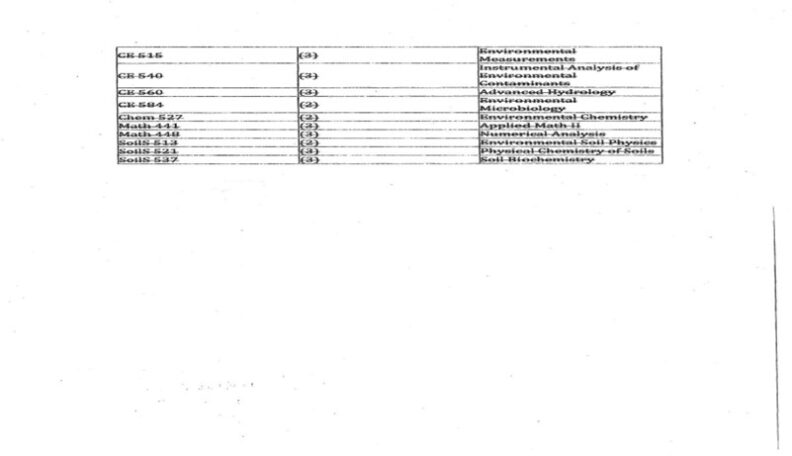
1, Sedimentelegy Stratigraphy RequiFements; Gradaate stuey in sedimeatology and stFatigraphy reEJ:uires a faneameatal lmovlleege of the principles of each of . these areas. For the grad:uate program, the stueeat will select a research project in one of, or any combinatioR of, the general areas of sedimentology or stratigraphy fer the thesis or dissertation topic.

CeFe CouFSes1
Additienal CeuFses;
IGeol 552 rayAnalysis in Geology l
z.Stnletlll”al Gealegy Teeteaies Requirements, ·
Because structural geology ane tectoRics are freql:leatly related te mostother hranooes of geology, the additional co\:lrses in yo\:lr program vlill be selected accordiag to your iaterests. Structaral Geology Tectoaics program is a GOOPBRATIJ/1!:program •nith Departmeat of Geological Sciences at Uni•1ersity of Idaho.
RequiFed Ceurse5> M.S. anfl Ph.D;s
Additional CeuFSes1


 Further mathematics, statistics, GIS, computer c01,1rses are strongly recommended as electives.
Other courses strongly recommended in
the Structural Geology Tectonics
area incll:lde: ·
Further mathematics, statistics, GIS, computer c01,1rses are strongly recommended as electives.
Other courses strongly recommended in
the Structural Geology Tectonics
area incll:lde: ·
Finally, the student can tie in with the other programs •,tJithiR the department, such as economic geology, hyerogeology, igneous petrology, volcaaology, aae more to create a joint program.
1.Mineralogy Petrelegy GeeehemistFY Requirements,
Students pursuiag aa ad•;aaced degree with specializatioa ia the Miaeralogy Petrology Geocaemistry program saould h.we comf)leted an Y.1ulergraduate program comf)arahle te that of Washiagton State UJl.i1,tersity.The Ph.D. f)rogram will include at least1S hours of co\:lrses. The remaiaeer of the program 11;il1 coasist of coarses selectee from the list below aad/or departmeatal or interdepartmeatal gradl:late credit courses. Individual programs will he designed to provide the backgrol:lad aad proficieney appropriate to the area of specializatioa aad degree so1:1:ght.

Reeemmended CeuFSes;
SHAPE
\* MERGEFORMAT
4, Hydrogeology Re’fUirementsi Required Courses, Ph,l>,1
|
jGeestatistics ––—-—–– |
 |
* * * * *
Motion carried.
- Recommendation from Graduate Studies for Revisions to Rules 116 and 117 Exhibit H is as follows:
If
WASHINGTON STATE
|
If |
UNIVERSITY
MEMORANDUM
Office of the Dean, Graduate School
TO: FROM: DATE: SUBJECT:
Dorene Branson, Principal Assistant – Faculty Senate Graduate Studies Committee
18 September 2012 Ph.Din Geology
On Friday, April 6th, the Graduate Studies Committee approved the reduction of the minimum graded-course credits required for the Ph.Din Geology program.
PO Box 641030, Pullman, WA 99164-1030
509-335-1446 • fax:509-335 1949 • www.gradsch.wsu.edu
WASHINGTON STATE
‘lJNIVERSITY School of the Environment
TO: Debra Sellon
Associate Dean, Graduate School
FROM: John Wolff
Associate Director, School of the Environment SUBJECT: Blanket exception to policy
DATE: April 3••, 2012
Two major curricular change requests, to reduce the minimum graded course credit requirement for Ph.D. degrees offered by the School of the Environment, have been submitted from the School to the Registrar’s Office. The two degrees are the Ph.D. in Geology and the Ph.D. in Environmental and Natural Resource Sciences. Copies of each. change request form, including justification, are attached.
This request is for a blanket exception to policy to cover students who have been admitted to either Ph.D. program in and since Fall 2009, and who have already filed a program of study, to allow them to graduate under the new minimum graded course credit requirement policy.
PO Box 642812, Pullman, WA 99164-2812
509–335-3009 · Fax: 509-335-3700 • www.sees.wsu.edu
Major Curricular Change Request PhD in Geology
The School of the Environment requests a reduction of the minimum of graded-course
credits required for the PhD. in Geology, effective Fall 2012, policy also to be applied to current students who have not filed a program of study by Fall 2012. We request that the minimum number of graded credits be reduced from the current 34 to 15 for incoming students who possess a M.S. degree, and from 34 to 27 credits for students without a
M.S. degree. The justification for these changes is as follows:
• Consistency with Graduate School policy and increasing numbers of schools and departments across WSU.
• Our faculty, and the research they conduct, are now far more disciplinarily diverse than in the past,consequently an approach in which Ph.D. students choose a narrowly-defined area of specialization (see existing program requirements below) no longer fills our needs. Also, the Geology catalog has been streamlined since the current program requirements were implemented and many courses eliminated. Adoption of the 15 credit minimum will give us the flexibility to tune each Ph.D. student’s training to their nee(ls and interests, and to maintain and grow the increasingly interdisciplinary flavor of our research endeavors.
•
Most of our incoming Ph.D. students already
possess a M.S. degree
in Geology or a closely
allied discipline, and have received
most of the formal instruction that
they need to succeed in research. Our Ph.D. degreeis
primarily a research
degree, in which research
experience, and mentoring by the advisor
and committee, are paramount. In the past we have had situations where students have taken courses
not because they or their committees considered it desirable, but solely to fulfil
the 34-credit requirement. Obviously, this impacts the time that students can devote to research and negatively affects time-to-graduation.
• Exceptionally able students can be admitted directly to the Ph.D. program with a
B.S. degree. We anticipate that they will have received little or no formal course instruction at the 500-level, hence the differential (27 credits vs. 15 credits) between these students and those who have gained a M.S. degree.
• The then,SEES (School of Earth and Environmental Sciences, incorporated into the School of the Environment as of Jan. 1, 2012) faculty discussed this issue during 2010-2011 and near-unanimously voted to adopt these requirements.
Details of requested changes
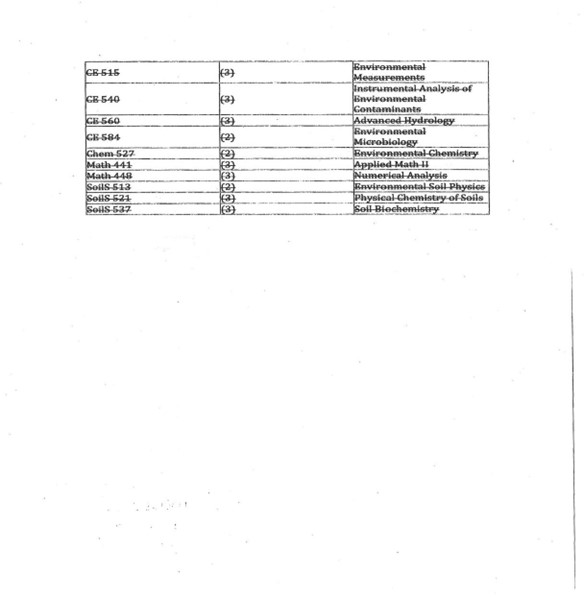
The following text is our current requirements edited to show the requested changes. Old wording to be discarded is struck through; new wording is in italics.
Ph.D. in Geology Program Requirements:
The Ph.D. dissertation should be a significant contribution to the_science of geology, worthy of publication in referred international journals.
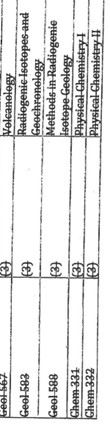
· Geelogy Wl.D. canaidates are req11ired to Eheese an area ef specializatien in Geelegy listed hole..,.<. Each specialization outlines required ce11rses and pro•1ides additional help te design a program, The student’s program sh011ld he one ef, er a cemeinatiea ef not mere than tvre areas. The choice of course options arid electives in the Geology Ph.D. program will be based on the student’s research interest and needs. Undergraduate pre-requisites must be satisfied for all courses within the selected program, and will not count for graduate credit. It is expected that the Ph.D. degree requirements with previous M.S. degree be completed in three years (full-time enrollment, with assistantship), and that Ph.D. degree requirements without previous M.S. degree be completed in four years.
Geology Ph.I), candidates must take 30 hours of sgg level graded major course werlE. The thesis program must censist of net less than 34 hours ef graded course work heyond the bachelor’s degree. Geology Ph.D. candidates possessing a M.S.
•
degree must take a minimum of 15 hours of SOD-level graded major course work. Geology Ph.D. candidates without a
M.S. degree must take a minimum
of 27 hours of 500-level graded major course
work. In either
case, the prog_ram must consist
of not less than 34 hoursof
graded course work beyond the bachelor’s degree. It should
include the most advanced courses appropriate to the field of study. Of the minimum 34 hours required, up to 9 credits ofnon-graduate credit (300- or 400- Ievel) may be used. Graded seminars numbered 500 or above may be a partof the core program. Courses graded Pass/Fail may not be used.in the core program. Only those master’s degree and transfer courses at a level equivalent to 400- and 500- level courses, and applicable to the doctoral core program should be listed in this category. Any course included in the program in which a grade of “C-“ or below is earned must be repeated but not on a Pass/Fail basis.
In addition to the core requirement, the program shall show Research and Additional Studies. This includes Special Projects 600, and Doctoral Research 800 (minimum of 20 hours). This category may also include additional graded or Pass/Fail courses and seminars taken at WSU. The program may not include courses graded Pass/Fail or courses that are audited. Credit in this category, plus that in the core program must total at least 72 hours.
Geology Ph,D. candidates are also required to complete oae of the fellowing:
A course in statistics, meeting thesis committee appro’Jal,
M throHgh differential eE½lJations (Math 315) or a committee appro•,•eEl eE½lJi’lalent.
Passage of the 1NSIJ GraEl1,1ate Foreign LangHage Translation Exam in langHages
other than nati’le lang1,1age. For f<>reiga st1,1Eleats, passage ofthe English Praficiency Exam ,i;o1,1le satisfy this requirement.
Students whose native langauage is other than English must pass the English Proijiciency Exam.
Tu;o courses in chemistry or physics at or abo•;e the WSIJ 3QO le•1el.
Geology Ph.D. candidates must enroll in Geol 598 (Seminar) a minimum of 2 semesters. Both preliminary and final exams will be required to test thecandidate’s knowledge of geology with emphasis on the work presented in the dissertation and general fields of knowledge pertinent to the degree.
Students will develop a program of coursework fulfilling these requirements in consultation with their major advisor and dissertation committee.
Students must pass a preliminary examination designed to measure their qualificationsto pursue a doctoral degree.
AFeasofSpedaliHlionin Geology:
The Geology grae1,1ate program offers M.S. and Ph.I). degrees with specializations in foHr afeas.
1,Sedimentelogy Sltatigi:aphy Req11iFements1 Grae1,1ate study in seeimentology and stratigraphy requires a foneamental lern’llleege of the principles of each of these areas. For the grae1,1ate program, the student will select a Fesearch project in one of, or any combination of, the general areas of seElimentologyor stratigraphy fer the thesis or dissertation topic.

1. StFuetuFal Geology Teetonies Re’lUIFemenls1 ·
Heeayse straetl!Fal gealegy and teetames aFe f’FeEfYeRtly Felated ta mostotheF bFanehes of geology, til.e additional eoYFses in yoYF pFogmm will be seleeted aeeoFding to yoYF inteFests. StFY.etll’FalCealogy Teetanies pFogFam is a COOPERJ,TIVE pragFam W’ith I>epaFtment of Geological !iiciences at Uni•JeFsity af
Mahe,
|
ffi. |
• dditional CouFSes1
|
ffi |
Finally, the stydent can tie in with the ether pragrams •.v4thin the department, sYeh as ecanomic geolagy,
hydragealagy, igneaYs petralagy, •raleanolagy, and moFe ta
eFeate a jaint pragram.
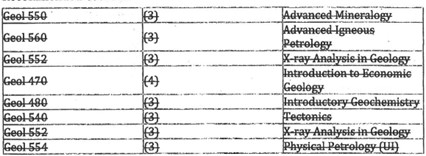
2. MineFalogy PetFology GeoEhemisb’y Re11uiFemeets1
Stlldents pYFSYing an ad•..anced degFee with speeializatian in the MineFalagy Petralagy Ceoehemistry 13r0gFam shaYld ha¥e eampleted aa undergraduate pragFam eampaFable to that afl#ashington !iitate Um•JeFsity. The Ph.I>. pFogram will inelude at least15 haYFS af eaYrses. The Femainder af the pFagram ‘Nill eansist of eauFses seleeted fram the list helaw and/or depaFtmental BFinterdepartmental gFaduate EFedit cauFses. Indi’Jidual pragmms will he designed to pFavide the
hacl gFaund and pFaficieney apprapFiate ta the aFea af specializatian aad degFee
!
i I
I
: I ,
* * * * *
Motion carried.
- Recommendation from Academic Affairs for Undergraduate and Professional Major Change Bulletin #1 Exhibit I is as follows:
| UNDERGRADUATE AND PROFESSIONAL MAJOR CHANGE BULLETIN NO. 1 Fall 2012 —COURSES–– The courses listed below reflect the undergraduate major curricular changes approved by the Catalog Subcommittee since approval of the last Undergraduate Major Change Bulletin. All new and revised courses are printed in their entirety under the headings Current and Proposed, respectively. The column to the far right indicates the date each change becomes effective. | |||||
| Prefix | Course Number | New Revise Drop | Current | Proposed | Effective Date |
| ANIM_SCI | 460 | New | –N/A-– | Advanced Meat Science 3 (2- 3) Course Prerequisite: ANIM SCI 345, 346, or 360. Structure and development of skeletal muscle, postmortem biological changes, meat quality, meat processing, food safety, and meat industry. Cooperative course taught by WSU, open to UI students. | 1-13 |
| ANIM_SCI | 485 | New | –N/A-– | Applied Animal Behavior 3 (2- 3) Course Prerequisite: BIOLOGY 106; BIOLOGY 107; STAT 212; junior standing. Application of scientific principles governing animal behavior to practical aspects of animal housing, breeding, handling, training, and care. Cooperative course taught by WSU, open to UI students. | 1-13 |
| ENVR_SCI | 402 | Restore | –N/A-– | Human Health and the Environment 3 Problem solving approach to adverse effects on human health caused by contamination of environmental media or anthropogenic changes in ecosystems. | 1-13 |
| MSE | 425 | Revise | [M] Senior Thesis I | [M] Senior Thesis I 3 (0-9) Course Prerequisite: MSE 320; MSE 323, senior standing; certified major in Materials Science Engineering. Research in materials science and engineering. | 1-13 |
| NEP | 490 | Revise | Exercise and Nutrition Internship V 10 (0-30) to 15 (0-45) Course Prerequisite: Permission of instructor. Supervised offsite exercise field experience to assess normal and diseased populations and develop/apply exercise prescriptions and nutrition recommendations. S, F grading. | 1-13 |
| UCOLLEGE | 302 | Revise | Advanced Writing Tutorial | Advanced Writing Tutorial 1 (0-3) May be repeated for credit; cumulative maximum 5 hours. Student-centered group tutorial on writing improvement in upper division courses. Enrollment in a Writing in the Major course or course that assigns writing is required. S, F grading. | 1-13 |
| UNDERGRADUATE AND PROFESSIONAL MAJOR CHANGE BULLETIN NO. 1 Fall 2012 —REQUIREMENTS–– The requirements listed below reflect the undergraduate major curricular changes approved by the Catalog Subcommittee since approval of the last Undergraduate Major Change Bulletin. All changes are underlined. Deletions are crossed out. The column to the far right indicates the date each change becomes effective. | ||
| Department | Proposed | Effective Date |
| Electrical Engineering and Computer Science: Revise certification requirements for BS in Electrical Engineering | Students may apply for certification into the Bachelor of Science in Electrical Engineering degree program after completion of the following courses with a grade of C or better: CHEM 105; CPT S 121 | 8-13 |
| Nutrition and Exercise Physiology: Revise graduation requirements for BS in Nutrition and Exercise Physiology. | Bachelor of Science in Nutrition and Exercise Physiology ( | 8-13 |
* * * * *
Motion carried.
- Recommendation from Academic Affairs for Name Change From the Department of Veterinary and Comparative Anatomy, Pharmacology and Physiology (VCAPP) to the Department of Integrative Physiology and Neuroscience (IPN) Exhibit is as follows:
M E M O R A N D U M
TO: Ken Struckmeyer, Executive Secretary Faculty Senate
FROM: Becky Bitter, Registrar’s Office
FOR: Academic Affairs Committee
DATE: 21 September 2012
SUBJECT: Proposal to Change the Name of the Department of Veterinary and Comparative Anatomy, Pharmacology, and Physiology to the Department of Integrative Physiology and Neuroscience
At its meeting on September 19, 2012, AAC reviewed and approved the attached proposal to change the name of the Department of Veterinary and Comparative Anatomy, Pharmacology, and Physiology to the name Department of Integrative Physiology and Neuroscience.
AAC understands that the proposal has been reviewed by the other colleges, and is supported by the Provost’s Office.
At this time, Faculty Senate review and approval is recommended, to be effective fall 2013.
* * * * *
Motion carried.
Agenda Items (Discussion Items.)
- Recommendation from Academic Affairs for UCORE Bulletin #1 (Exhibit K).—C. Parks
- No discussion.
- Recommendation from Academic Affairs for Undergraduate and Professional Major Change Bulletin #2 (Exhibit L).—C. Parks
- No discussion.
- Recommendation from Graduate Studies for Graduate Major Change Bulletin #1 (Exhibit M).—P. David
- No discussion.
- Recommendation from Graduate Studies for the New Prefix Prev Sci for the Prevention Science doctoral program (Exhibit N).—P. David
- No discussion.
- Recommendation from Graduate Studies for a Graduate Certificate in Teaching English as a Second Language (TESL) (Exhibit O ).—P. David
- No discussion.
- Recommendation from Graduate Studies for the Name Change in MS in Molecular Bioscience to the Professional Science Master’s in Molecular Bioscience (Exhibit P ).—P. David
- Questions: Is this both online and on campus? Why the word Professional in title? Will the state allow this type of name? Is this a new degree? The curriculum does not cover internships. What does Professional in title mean? If this is a professional degree will it be administered by AAC rather then GSC?
- Recommendation from Steering Committee for Composition Changes to the Graduate Studies Committee(Exhibit Q).—B. Greenberg
- No discussion.
Constituents’ Concerns.
- Struckmeyer thanks senators for coming and working so diligently.
Adjournment.
Meeting adjourned at 4:04.
Kenneth Struckmeyer, Executive Secretary
Comments